Launching private label sweeteners typically involves choosing the right sweetener, selecting suitable packaging, confirming order volumes, reviewing label requirements, and coordinating production and distribution with a bulk supplier. Each decision can affect cost, lead time, product quality, and the ability to support repeat orders.
This guide is for retailers, distributors, foodservice suppliers, beverage brands, and food manufacturers that want to sell sugar or sweeteners under their own brand. US Sweeteners supports private-label and co-pack buyers with bulk ingredients, custom packaging options, quality documentation, and nationwide distribution.
What Are Private Label Sweeteners?
Private label sweeteners are sugar or sweetener products supplied, produced, blended, or packaged by one company and sold under another business’s brand. The brand owner controls the customer-facing identity, while the supplier handles the agreed ingredient, production, packaging, or distribution work.
A private-label program can be simple or highly customized. One retailer may place its label on a standard package of granulated sugar. Another business may need a specific sweetener blend, package weight, flavor profile, case pack, and delivery plan for several warehouses.
Private labeling also differs from buying an ingredient for internal production. A bakery that purchases bulk granulated sugar for its recipes is a bulk ingredient buyer. A distributor that sells the sugar in packages carrying its own brand is operating a private-label program.
How Does Private Label Sweetener Production Work?
A private label sweetener launch usually moves through product development, packaging selection, label review, commercial approval, production, and delivery. The order may involve a standard sugar, a low-calorie sweetener, or a custom blend, but every successful program begins with clear specifications and realistic demand estimates.
1. Define the Product and Its Intended Use
Start with the finished product rather than the package design. A sweetener that works well in coffee packets may not provide the taste, texture, weight, or heat performance needed for baking or beverage production.
Your supplier will need to understand:
- The type of sweetener
- The target sweetness level
- The intended food or beverage
- Whether the product needs bulk or consumer packaging
- Any purity, texture, color, or flavor requirements
- Required quality or sourcing documentation
For example, standard sucrose may fit an own-brand table sugar line, while a reduced-sugar product may use stevia, erythritol, sucralose, or a carefully designed blend. The formula must account for more than sweetness because sugar can also affect texture, weight, browning, moisture, and product structure.
2. Choose a Suitable Packaging Format
Packaging must fit the product, sales channel, and expected order volume. It also needs to protect the sweetener during storage and transportation.
Common private-label formats may include:
| Packaging Format | Common Use | Key Consideration |
| Stick packs | Coffee, tea, hospitality, travel | Filling accuracy and print area |
| Sachets or packets | Tabletop and foodservice | Case quantity and moisture protection |
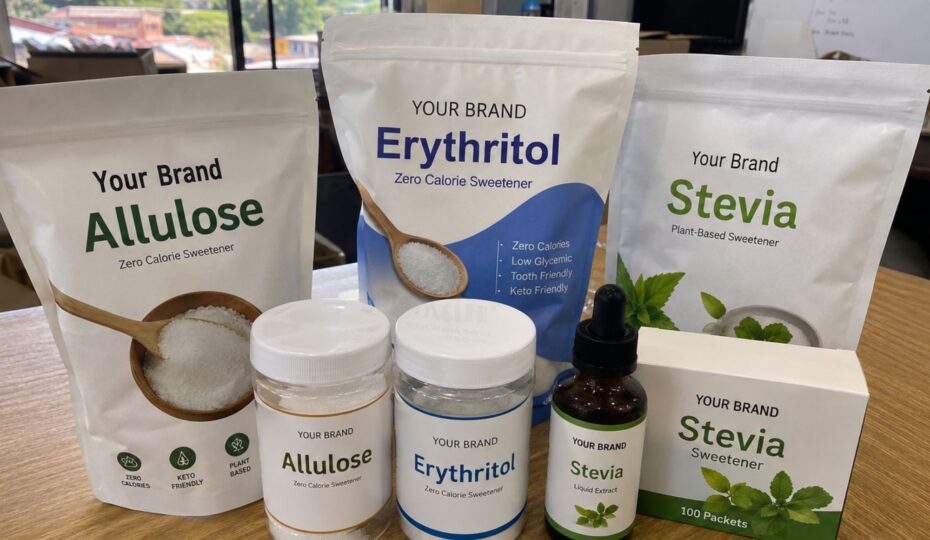
| Pouches | Retail and refill products | Closure, barrier strength, and shelf display |
| Canisters | Consumer and specialty blends | Container cost and label space |
| Bags | Retail, foodservice, and wholesale | Seal strength and package weight |
| Drums or totes | Liquid or industrial supply | Handling equipment and delivery access |
A co-pack sugar brand may require custom-printed film, while a smaller launch may use a stock package with a pressure-sensitive label. Printed packaging can strengthen brand recognition, but it can also create a separate minimum-order and inventory commitment.
3. Confirm Volume, Timing, and Delivery Needs
Your first order should reflect expected sales, storage space, and the amount of branded packaging you can reasonably use. Ordering more may reduce the per-unit price, but it also ties up cash and warehouse space.
Tell the supplier how much you expect to order, how often you may reorder, and where the finished product must ship. Multi-location distribution requires planning by destination so one warehouse does not run out while another holds excess stock.
US Sweeteners supplies bulk products to private-label brands, co-packers, and contract manufacturers through a multi-warehouse distribution network. Available documentation includes Certificates of Analysis and lot traceability for quality-assurance and contract-manufacturing needs.
Private Label vs. White Label Sweeteners
Private-label sweeteners may include a product, specification, or package developed for one brand. White-label sweeteners generally use a standard product that several businesses can sell under their own labels. However, suppliers do not always use these terms consistently, so buyers should confirm customization and exclusivity in writing.
| Factor | Private Label | White Label | Standard Bulk Supply |
| Branding | Buyer’s brand | Buyer’s brand | Supplier or generic packaging |
| Formula | May allow customization | Usually standardized | Standard ingredient |
| Packaging | Often customized | Limited choices | Commercial bulk formats |
| Exclusivity | May be negotiated | Usually nonexclusive | Nonexclusive |
| Launch time | Usually longer | Often faster | Usually shortest |
| Best use | Differentiated product line | Faster market entry | Internal food production |
Custom sweetener packaging does not always mean the formula is exclusive. A supplier may place the same standard sugar or sweetener into packages designed for different brands. Buyers should ask who owns the formula, whether other brands can purchase it, and what happens to unused packaging if the program ends.
Which Sweeteners Can You Sell Under Your Brand?
Private-label programs can use traditional sugars, liquid sweeteners, high-intensity sweeteners, sugar alcohols, or blends. The best choice depends on the product’s desired taste, sweetness, texture, calories, label position, price, and production process.
The following options illustrate common B2B applications:
| Sweetener | Common Private-Label Use | Main Formulation Issue |
| Granulated sugar | Retail bags, baking, foodservice | Crystal size and package durability |
| Powdered sugar | Baking and confectionery | Particle size and moisture protection |
| Liquid sugar | Beverage products, sauces, syrups | Container type and pumping requirements |
| Stevia | Reduced-sugar products and tabletop blends | Sweetness intensity and taste profile |
| Sucralose | Drinks, dry mixes, and sugar-free products | Very high sweetness intensity |
| Erythritol | Baking blends and reduced-sugar products | Bulk, cooling effect, and texture |
| Dextrose | Baking, beverages, and fermentation | Lower sweetness than sucrose |
| Custom blends | Tabletop, cooking, baking, or beverages | Ingredient ratios and consistent mixing |
US Sweeteners offers bulk confectioners sugar in several particle sizes and bulk liquid sugar in formats suited to commercial food and beverage production. Its broader bulk sweetener range includes sugar-reduction ingredients, polyols, corn sweeteners, and specialty options.
Considerations for Stevia Products
Stevia sweeteners use purified steviol glycosides associated with the leaves of Stevia rebaudiana. The FDA notes that high-purity steviol glycosides can deliver roughly 200 to 400 times the sweetness of table sugar, so formulators use far less by weight. The agency distinguishes these purified ingredients from whole stevia leaves and crude extracts, which are not considered GRAS for use as sweeteners in the United States.
Stevia can appear in powder, liquid, or blended products. Different glycoside profiles can also change the taste. For example, a formulation developer may compare Reb A and Reb M when trying to reduce bitter or lingering notes, but the final choice depends on the recipe, cost target, and desired flavor.
Because stevia has high sweetness but little bulk, it cannot always replace sugar on its own in baking or powdered products. A blend may need erythritol, dextrose, maltodextrin, or another ingredient to restore volume, texture, and handling performance.
What Are the Benefits of Private Label Sweeteners?
Private label sweeteners can help retailers and distributors build an own-brand product range, strengthen customer recognition, and respond to demand for traditional, reduced-sugar, or specialty sweetening options. The commercial value depends on reliable product quality, clear positioning, sensible pricing, and steady supply.
The main benefits include:
- Greater brand control: Your business controls the name, visual design, package message, and market position.
- Product differentiation: You can choose formats and ingredient profiles that match the needs of your customers.
- Pricing flexibility: Your company can create its own wholesale or retail pricing model.
- Faster product-line growth: Private labeling can avoid the cost of building an ingredient plant and packaging operation from the ground up.
- Stronger customer retention: A useful product available only through your company can encourage repeat orders.
These benefits do not guarantee higher margins. A successful program must account for ingredient cost, packaging, production, freight, storage, marketing, and expected sell-through.
What Affects Private Label Sweetener Costs and MOQs?
Private-label sweetener costs depend on the ingredient, package, order size, printing method, filling requirements, storage, and freight. Minimum order quantities, or MOQs, may also reflect the amount of packaging a printer produces efficiently rather than only the amount of sweetener being purchased.
A simple planning model is:
Total delivered cost = ingredient + packaging + packing + storage + freight + program-specific fees
This model helps buyers compare complete programs, but it does not replace a formal quote. The following factors can change the final price:
| Cost Factor | Why It Matters |
| Sweetener type | Standard sugar and specialty ingredients have different costs |
| Package size | Small units require more materials and filling work |
| Packaging design | Custom printing may carry setup costs and minimums |
| Order volume | Volume affects production and freight efficiency |
| Product blend | Multiple ingredients require added development and mixing |
| Quality requirements | Special sourcing or documents may affect availability |
| Warehousing | Finished goods and unused packages take up space |
| Freight | Weight, distance, pallet size, and access affect delivery cost |
Before accepting a low unit price, ask how much packaging you must buy and where unused materials will remain. A modest first run can cost more per unit but reduce the risk of carrying months of unsold inventory.
How Do Food Label Rules Affect a Private-Label Launch?
A private-label food package must identify the product accurately and include the information required for that product and sales channel. Depending on the item, this may involve an ingredient statement, Nutrition Facts, allergen information, net quantity, business identification, and any required statements linked to specific sweeteners.
The FDA requires food labels to identify high-intensity sweeteners by name in the ingredient list. Products containing aspartame must also inform people with phenylketonuria that the product contains phenylalanine.
Claims such as “sugar-free,” “reduced sugar,” “organic,” “natural,” “gluten-free,” or “vegan” need proper support. Ingredient quality alone does not make every claim suitable for the finished package. Establish who will create, review, approve, and update the label before you print a large packaging order.
How to Choose a Private Label Sugar Supplier
A private label sugar supplier should offer more than a competitive price. It must understand ingredient specifications, custom sweetener packaging, quality documentation, inventory planning, and freight. The supplier should also communicate clearly when an ingredient, package, or delivery requirement could affect the launch.
Use these questions during your supplier review:
- Can the supplier meet the required ingredient specification?
- Which package formats and weights can it support?
- What drives the minimum order quantity?
- Who manages artwork and label approval?
- What quality documents come with each order?
- Can the supplier provide lot traceability?
- Where will ingredient and finished-goods inventory be held?
- Can orders ship to more than one location?
- How will the supplier handle shortages or delayed packaging?
- What information does it need for accurate repeat orders?
US Sweeteners supplies products such as bulk granulated sugar, bulk liquid sucrose, bulk sucralose, and bulk dextrose for commercial food and beverage production. Its private-label supply page also identifies granulated sugar, brown sugar, dextrose, maltodextrin, erythritol, stevia, monk fruit, and syrups as common options for private-label products.
What Should You Prepare Before Requesting a Quote?
A supplier can prepare a more accurate quote when you provide clear product, packaging, volume, and delivery details. Without this information, an early price may overlook printing, filling, warehousing, or freight requirements that materially affect the program.
Prepare the following details:
- Sweetener type and intended use
- Required product specification
- Target sweetness and flavor profile
- Package style and net weight
- Estimated first order
- Expected annual volume
- Finished or draft artwork
- Required certifications or documents
- Number of delivery locations
- Receiving ZIP codes
- Target launch date
- Expected reorder schedule
Separate firm requirements from preferences. For example, the ingredient specification may be fixed, while the package size may be flexible. This distinction gives the supplier room to suggest a more practical or cost-effective solution without changing the product’s essential needs.
Conclusion
A successful private-label launch connects the formula, package, label, order volume, inventory, and delivery plan. Choosing each part separately can create delays and added costs, while planning them together gives your business a clearer path from new product development to repeat orders.
US Sweeteners helps retailers, distributors, co-packers, and food manufacturers source private label sweeteners and custom-packaged ingredients for U.S. markets. Request product and pricing information to discuss your ingredient specifications, packaging design, order volume, quality needs, and delivery locations.
FAQs
What are private label sweeteners?
Private label sweeteners are sugar or sweetener products made, supplied, blended, or packaged for sale under another company’s brand. The buyer usually controls the customer-facing brand and package requirements. The supplier’s role may include ingredient sourcing, packing, documentation, warehousing, or delivery.
Can a company sell sugar under its own brand?
Yes, a company can work with a private label sugar supplier or co-packer to sell sugar under its own brand. The parties must agree on the ingredient, package, label, quantity, and distribution plan. Buyers should also clarify who approves the final food label.
What is the difference between private label and white label sweeteners?
Private-label sweeteners may include custom specifications or packaging developed for one business. White-label sweeteners generally use a standard product that several businesses can sell under different labels. Because suppliers use these terms differently, confirm formula ownership, customization, and exclusivity in the contract.
What is the minimum order for private label sugar?
There is no universal minimum order for private label sugar. The MOQ may depend on ingredient volume, package size, printed-material requirements, production setup, and case or pallet configuration. Request a quote based on your exact product rather than relying on a general industry estimate.
What affects the cost of private label sweeteners?
The main cost factors include the sweetener, formulation, package, printing method, order volume, packing work, storage, and freight. Specialty ingredients or additional documents may also affect the price. Compare total delivered cost rather than focusing only on the price per pound.
How long does it take to launch a private label sweetener?
Timing depends on ingredient availability, formula work, packaging selection, artwork approval, label review, production scheduling, and transportation. A standard product in a stock package may move faster than a custom blend in printed packaging. Ask the supplier to map each stage before setting your market launch date.

Thomas is a product expert at US Sweeteners, a trusted bulk sugar and sweetener distributor serving food and beverage manufacturers across the USA. He writes about sweetener sourcing, ingredient trends, and supply chain insights for the food industry.