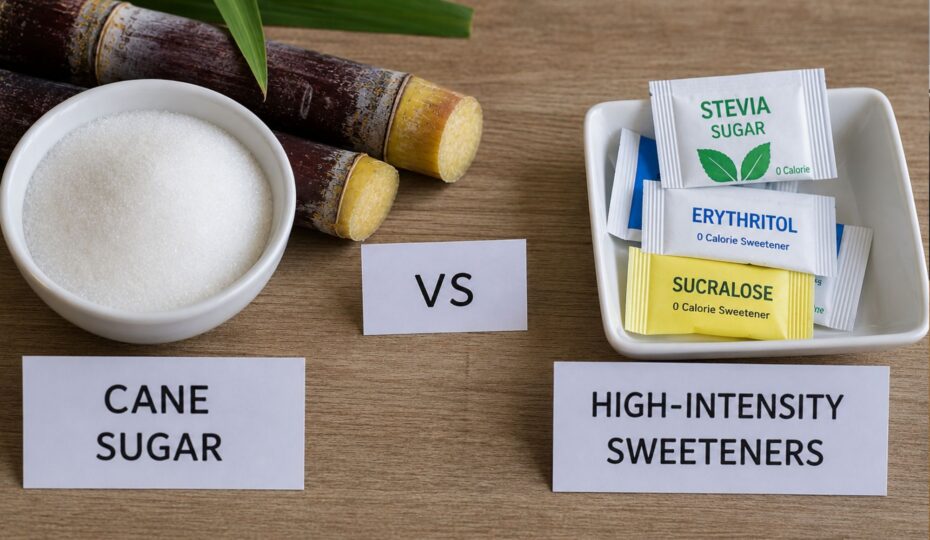
Comparing cane sugar vs. high-intensity sweeteners by price per pound can lead procurement teams to the wrong conclusion. Cane sugar costs less per pound than stevia, sucralose, or monk fruit, but manufacturers need far less of these high-intensity ingredients to reach the same sweetness.
This guide gives food and beverage R&D teams a practical way to compare cost per sweetness equivalence. It uses 2026 benchmark prices, relative sweetness ranges, and a beverage reformulation example. For pricing based on your specifications and delivery location, request a bulk sweetener quote from US Sweeteners.
What Is Cost Per Sweetness Equivalence?
Cost per sweetness equivalence measures how much an ingredient costs to provide the sweetness of one pound of sucrose. It gives procurement and R&D teams a more useful comparison than price per pound alone. However, it does not include bulking agents, flavor adjustments, processing changes, freight, or other reformulation expenses.
This article uses one sucrose equivalent unit, or SEU, as the sweetness provided by one pound of sucrose. Because sucrose serves as the standard reference, it has a relative sweetness value of 1 and provides one SEU per pound.
The basic calculation is:
Cost per SEU = ingredient price per pound ÷ relative sweetness
For example, an ingredient costing $10 per pound may appear expensive. However, if it delivers 500 times the sweetness of sucrose, its theoretical sweetener cost is only $0.02 per SEU.
Why Price per Pound Can Mislead Buyers
A manufacturer may need 1,000 pounds of bulk granulated sugar but less than two pounds of a high-intensity sweetener to reach comparable sweetness. That difference can make a high-priced ingredient economical on a sweetness-only basis.
Still, sweetness equivalence does not equal formula equivalence. Cane sugar also supplies weight, solids, body, browning, moisture control, and other functional properties that concentrated sweeteners do not provide.
How Do 2026 Sweetener Costs Compare?
Based on 2026 benchmark prices, sucralose provides the lowest theoretical cost per unit of sweetness among the ingredients compared. Stevia can also cost less per sweetness unit than sucrose. Monk fruit may cost more, depending on mogroside concentration and sweetness strength, while HFCS 55 remains close to sucrose on a dry-weight sweetness basis.
The U.S. Department of Agriculture reported an average 2026 bulk refined cane sugar benchmark of about $0.48 per pound through June. Its Midwest delivered dry-weight benchmark was approximately $0.47 per pound for HFCS 55 and $0.35 for HFCS 42. Current data are available in the USDA Sugar and Sweeteners Yearbook Tables.
Specialty sweetener prices do not have one national public benchmark. The values below use indicative 2026 bulk market ranges and should not replace a supplier quote. Purity, grade, origin, minimum order, certifications, packaging, tariffs, freight, and contract terms can change landed costs substantially.
| Sweetener | Illustrative 2026 Price | Relative Sweetness vs. Sucrose | Estimated Cost Per SEU |
| Sucrose or cane sugar | $0.48/lb | 1× | $0.48 |
| HFCS 55, dry basis | $0.47/lb | About 1× | $0.47 |
| Stevia Reb A | $50–$90/kg | 200–300× | $0.08–$0.20 |
| Stevia Reb M | $100–$180/kg | 200–300× | $0.15–$0.41 |
| Sucralose | $14.50–$21/kg | About 600× | $0.011–$0.016 |
| Monk fruit, 50% mogroside V | $260–$345/kg | 150–250× | $0.47–$1.04 |
The U.S. Food and Drug Administration notes that high-intensity sweeteners can range from hundreds to thousands of times sweeter than table sugar. Its high-intensity sweetener guidance also explains the regulatory status and acceptable daily intake for approved ingredients.
How the Calculation Works
Consider sucralose at an illustrative $16 per kilogram:
- Convert the price to pounds: $16 ÷ 2.2046 = $7.26 per pound
- Divide by its relative sweetness: $7.26 ÷ 600
- The theoretical cost equals about $0.012 per SEU
The same formula applied to Reb A at $70 per kilogram and 250 times sucrose sweetness gives an estimated cost of about $0.13 per SEU.
These figures show why high-intensity sweeteners may reduce direct sweetener cost. They do not show the full cost of reformulating a food or beverage.
Why Is Sucrose Equivalence Only a Starting Point?
Sucrose equivalence measures sweetness but does not capture how an ingredient behaves in a finished product. Cane sugar adds mass, soluble solids, mouthfeel, browning, moisture retention, fermentation capacity, and freezing-point control. Removing it can create new costs for bulking agents, flavors, stabilizers, equipment changes, testing, and production losses.
A sweetness-equivalent amount of sucralose, stevia, or monk fruit occupies only a small fraction of the space left by sugar. Manufacturers may need fibers, starches, sugar alcohols, hydrocolloids, or other solids to rebuild the formula.
Cane sugar can perform several jobs:
- Add bulk and dissolved solids
- Support browning and caramelization
- Improve body and mouthfeel
- Retain moisture in baked goods
- Control crystallization in confectionery
- Provide fermentable carbohydrate
- Affect freezing behavior in frozen desserts
- Balance acidity, bitterness, and flavor
A high-intensity sweetener may replace the sweetness function while leaving the other seven functions unresolved.
Total Sugar Replacement Cost
A more complete procurement model should calculate:
Total replacement cost = high-intensity sweetener + bulking system + flavor system + process changes + testing + freight + expected production loss
This broader calculation may change the ranking. Sucralose can have a very low cost per SEU, but a beverage may need added flavors or stabilizers. A baked product may require significant bulk replacement, making the total system more expensive than its sweetener cost suggests.
How Do Sucrose, HFCS, Stevia, Sucralose, and Monk Fruit Differ?
Sucrose and HFCS provide both sweetness and physical solids, while stevia, sucralose, and monk fruit primarily provide concentrated sweetness. Sucralose often produces the lowest sweetness cost, but label goals may favor stevia or monk fruit. Sucrose may remain more economical when texture, browning, fermentation, or mouthfeel carries significant value.
| Ingredient | Main Procurement Advantage | Main Formulation Limitation |
| Cane sugar | Familiar taste and multiple functional roles | Requires more volume and adds calories |
| HFCS 55 | Liquid handling and sucrose-like sweetness | Adds water and may not fit every label strategy |
| Reb A stevia | High potency and plant-derived positioning | Can produce bitter or lingering notes |
| Reb M stevia | Often offers a more sugar-like profile than Reb A | Usually costs more than Reb A |
| Sucralose | Very low theoretical cost per SEU | Does not provide bulk or sugar functionality |
| Monk fruit | Fruit-derived positioning and high potency | Higher ingredient cost and variable flavor profile |
Manufacturers can source bulk HFCS 42 and HFCS 55 in liquid systems suited to beverages, sauces, processed foods, and other high-volume applications. HFCS 55 has sweetness close to sucrose, while HFCS 42 generally provides less sweetness.
For sugar-reduction projects, US Sweeteners also supplies bulk stevia extract, bulk sucralose, and bulk monk fruit sweetener. Actual selection should reflect the target flavor, use level, processing conditions, regulatory requirements, and finished-product claims.
What Does a Beverage Reformulation Cost?
In a simplified beverage example, replacing half of the sucrose sweetness with sucralose cuts direct sweetener cost by nearly 49%. The theoretical saving is substantial because sucralose supplies hundreds of times more sweetness per pound. However, the manufacturer must still price any changes to body, flavor, acidity, labeling, testing, and production.
Assume a beverage producer makes a 10,000-liter batch containing 10% sucrose by weight. For a simplified comparison, the formula uses 1,000 kilograms of sucrose.
At the USDA benchmark of $0.48 per pound:
1,000 kg × 2.2046 × $0.48 = $1,058.21
Now assume the manufacturer retains half the sugar and replaces the other half of the sweetness with sucralose.
Worked 50% Sugar-Reduction Example
| Cost Component | Calculation | Estimated Cost |
| Retained sucrose | 500 kg × 2.2046 × $0.48/lb | $529.10 |
| Sucrose sweetness replaced | 500 kg ÷ 600 | 0.833 kg sucralose |
| Sucralose | 0.833 kg × $16/kg | $13.33 |
| Total direct sweetener cost | $529.10 + $13.33 | $542.43 |
| Direct sweetener saving | $1,058.21 − $542.43 | $515.78 |
| Percentage saving | $515.78 ÷ $1,058.21 | 48.7% |
The calculation looks attractive, but it excludes the cost of restoring lost solids and mouthfeel. Reducing 500 kilograms of sugar changes more than sweetness. The R&D team may need to rebalance water, acid, flavor, stabilizers, preservatives, or other solids before the beverage performs like the original.
Procurement should therefore request prices for the complete replacement system, not only the high-intensity sweetener.
How Should Manufacturers Compare Sugar Replacement Costs?
Manufacturers should compare total delivered formula cost rather than focusing on ingredient price or sweetness potency alone. The analysis should include relative sweetness, purity, use level, supporting ingredients, freight, storage, dosing equipment, quality documentation, sensory testing, and expected production losses. Each variable can affect the real cost of commercial scale-up.
Use the following process before approving a new sweetener system:
- Set the reformulation target. Define the desired reduction in added sugar, calories, or ingredient cost.
- Identify every function of the current sugar. Include sweetness, solids, body, browning, moisture, fermentation, and preservation.
- Calculate the theoretical SEU requirement. Use a realistic sweetness factor for the specific product matrix.
- Price the supporting system. Add bulking agents, flavors, stabilizers, and process aids.
- Include delivered cost. Account for packaging, freight, tariffs, storage, and order size.
- Run sensory and stability tests. Check sweetness onset, aftertaste, mouthfeel, color, shelf life, and consumer acceptance.
- Validate at production scale. Small ingredient quantities may require more precise dosing and mixing controls.
Relative sweetness is not a fixed universal number. Temperature, pH, concentration, flavor system, and other ingredients can change perceived sweetness. R&D teams should use published values for initial modeling, then confirm the actual sucrose equivalence through bench and pilot testing.
US Sweeteners can help procurement teams compare ingredient forms, packaging, order volumes, and nationwide delivery requirements when building a commercial cost model.
Are Health Claims Part of a Cost-Per-Sweetness Decision?
Health and nutrition goals may drive a sugar-reduction project, but they should remain separate from the cost calculation. High-intensity sweeteners can reduce added sugar and may produce little immediate blood glucose response at typical use levels. However, regulatory safety, dietary guidance, consumer preference, and long-term health research are different considerations.
The FDA considers approved high-intensity sweeteners safe under their intended conditions of use and publishes acceptable daily intake values. The agency’s assessment does not mean every ingredient provides the same nutrition, gut health, appetite, or consumer-perception outcome.
Cane sugar is a simple carbohydrate made of equal parts glucose and fructose. Excess added sugar intake may contribute to obesity, insulin resistance, tooth decay, heart disease, and other metabolic problems. Public health guidance therefore focuses on limiting overall added sugars rather than treating cane sugar as a source of meaningful nutritional benefits.
The American Heart Association’s added sugar guidance recommends no more than 36 grams per day for most men and 25 grams for most women. Those figures are stricter than a general limit of 50 grams and should not be confused with a manufacturing use limit.
Conclusion
Cane sugar, HFCS, stevia, sucralose, and monk fruit should be compared by total formula value, not price per pound alone. Cost per SEU reveals the price of sweetness, while pilot testing reveals the cost of maintaining taste and performance. Procurement must then add freight, packaging, storage, documentation, and supply reliability.
US Sweeteners supplies bulk sugars and sugar-reduction ingredients to food manufacturers, distributors, bakeries, breweries, and beverage producers across the United States. Contact us to request current pricing for your required grade, quantity, packaging format, and delivery schedule.
FAQs
What is a sucrose equivalent sweetener calculation?
A sucrose equivalent calculation estimates how much of another sweetener produces the sweetness of a set amount of sucrose. Divide the target sucrose weight by the alternative ingredient’s relative sweetness. R&D teams should then confirm the result through sensory testing because food composition and processing can change perceived sweetness.
Which sweetener has the lowest cost per sweetness equivalence?
Sucralose often has the lowest theoretical cost per SEU because it is about 600 times sweeter than sucrose. Stevia may also cost less per sweetness unit than cane sugar, depending on its grade, purity, and sweetness strength. The lowest-cost ingredient may not create the lowest-cost finished formula after bulking and flavor adjustments.
Can stevia or sucralose replace cane sugar one for one?
No. They can replace sweetness but cannot replace sugar’s weight, volume, browning, moisture, or texture one for one. Manufacturers usually need supporting ingredients and process changes, especially in baked goods, confectionery, dairy products, and frozen foods.
Why does Reb M cost more than Reb A?
Reb M occurs at lower levels in the stevia leaf and has historically required more complex extraction, conversion, or fermentation processes. Many formulators consider its sweetness profile closer to sucrose, which may reduce the need for flavor masking. Its higher purchase price can therefore be offset partly by sensory or formulation benefits.
Is monk fruit cheaper than cane sugar?
Monk fruit may cost more than cane sugar when measured strictly by sucrose-equivalent sweetness, especially at higher mogroside concentrations. Brands may still choose it for fruit-derived positioning, sugar reduction, or a specific flavor strategy. Buyers should compare the total formula cost and not assume its high potency guarantees savings.

Thomas is a product expert at US Sweeteners, a trusted bulk sugar and sweetener distributor serving food and beverage manufacturers across the USA. He writes about sweetener sourcing, ingredient trends, and supply chain insights for the food industry.