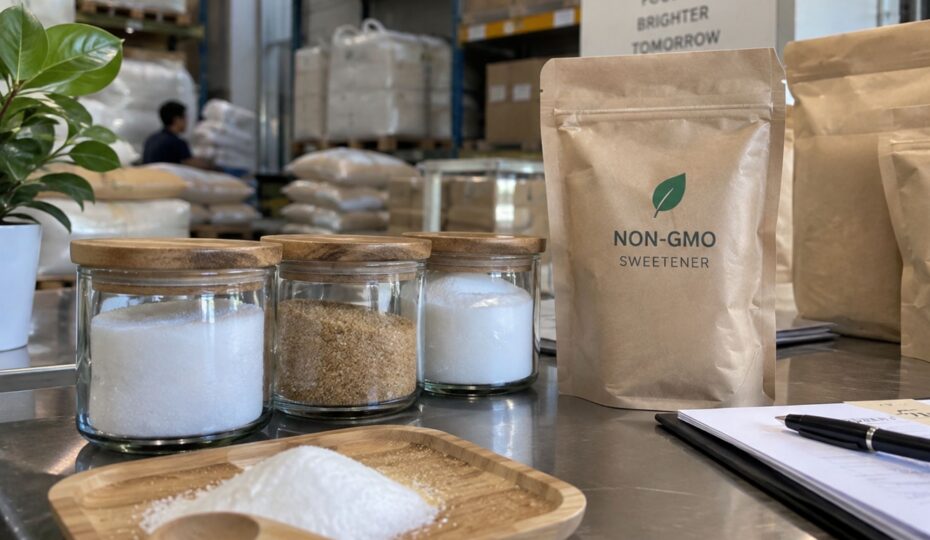
A non-GMO sweetener supplier should be able to tell you more than whether an ingredient carries a claim on the label. Bulk buyers need to know exactly what has been verified, which documents support the claim, whether certification follows the ingredient through the supply chain, and how that choice affects availability and cost.
This guide is for food and beverage manufacturers, bakeries, beverage brands, distributors, and other commercial buyers sourcing clean label sweeteners at scale. US Sweeteners supplies bulk sugars and sweeteners across a wide range of formats, and buyers can request product-specific documentation when evaluating an ingredient for a new or existing formulation. Contact US Sweeteners to discuss the sweetener, certification requirements, volume, and packaging your operation needs.
What Should Bulk Buyers Verify in a Non-GMO Sweetener?
Before purchasing a non-GMO sweetener, buyers should verify the exact product, ingredient source, supporting documentation, lot traceability, certification status, and chain of custody where applicable. A broad supplier claim is not enough when a finished food or beverage must meet a retailer, certification, customer, or internal clean label standard.
The first question should be simple: What evidence supports the claim for this exact SKU? US Sweeteners states that its bulk portfolio includes products with non-GMO availability and provides certificates of analysis and lot-level documentation across its sweetener range where applicable. Buyers sourcing bulk granulated sugar, for example, can also confirm cane or beet origin when the source matters to their specification.
A practical review should cover:
- Exact ingredient and grade
- Country and agricultural source where relevant
- Supplier non-GMO statement
- Third-party verification, if required
- Certificate of Analysis
- Lot-to-lot traceability
- Organic or sustainability certificates
- Packaging and handling controls
- Chain-of-custody records when a program requires them
Robust traceability matters because a buyer needs to connect the certificate or statement to the material actually received, not just to a general ingredient category.
What Does Non-GMO Project Verified Mean?
Non-GMO Project Verified means a product has been evaluated under the Non-GMO Project’s Product Verification Program against its published Standard. The mark represents third-party verification to that program’s requirements; it is more specific than a supplier simply describing an ingredient as non-GMO.
The program uses independent technical administrators to evaluate products. The Non-GMO Project also makes an important distinction: its verification mark does not mean “GMO-free,” because testing and supply-chain limitations make an absolute zero-GMO claim difficult to establish.
For a bulk buyer, this certification is most useful when:
- A retailer or customer specifically asks for Non-GMO Project Verified ingredients
- The finished product will pursue Non-GMO Project verification
- The brand makes non-GMO positioning a central front-of-pack claim
- The ingredient comes from a supply chain where genetic-engineering controls require closer review
Third-party verification should support the commercial requirement. If a customer only asks for a supplier non-GMO statement, paying for a more complex verification program may not add enough value to justify the extra sourcing constraints.
Is USDA Organic the Same as Non-GMO?
USDA Organic and non-GMO are related, but they are not interchangeable claims. USDA organic rules prohibit genetic engineering as an excluded method, while organic certification also covers a much broader system of agricultural production, handling, recordkeeping, and approved inputs.
That distinction matters when purchasing organic bulk sugar. A brand developing a USDA Organic beverage, snack, baked good, or dietary supplement generally needs organic-certified ingredients and the required chain-of-custody documentation rather than a standalone non-GMO statement.
| Claim | Main Focus | Most Relevant When |
| Non-GMO Project Verified | GMO avoidance against a third-party standard | Non-GMO positioned brands and retailer requirements |
| USDA Organic | Organic farming and handling rules that prohibit genetic engineering | Certified organic food and beverage products |
| Supplier non-GMO statement | Product-specific supplier declaration | Buyer specifications that do not require third-party certification |
USDA specifically states that genetic engineering cannot be used in organic production. However, buyers should still match the certification to the finished product claim they intend to make rather than treating “organic,” “non-GMO,” and “natural” as synonyms.
What Do Fair Trade, Bonsucro, and Regenerative Certifications Verify?
Fair Trade, Bonsucro, and regenerative certifications address sustainability and social or agricultural practices rather than serving as substitutes for non-GMO verification. They can still matter to clean label brands whose sourcing claims extend beyond ingredient composition to worker welfare, agricultural practices, traceability, and environmental performance.
Fair Trade Certified
Fair Trade Certified standards cover social, economic, and environmental requirements, including working conditions, compensation, environmental protections, and traceability. Sugar is among the commodities that can earn Fair Trade certification.
Fair Trade makes the most sense for brands that actively market responsible sourcing or whose customers and retailers require it. It can also create a direct premium component in the supply chain, so buyers should ask their supplier to separate the ingredient price, certification premium, and freight impact when possible.
Bonsucro
Bonsucro focuses specifically on more sustainable sugarcane production and traceable sugarcane supply chains. Its system includes standards for production and the trading side of the supply chain, helping buyers evaluate environmental and social performance around cane-derived sugar.
For a brand buying cane sugar at scale, Bonsucro may be more relevant than a broad sustainability label because it directly addresses sugarcane. However, it does not replace USDA Organic or Non-GMO Project verification when those claims are separately required.
Regenerative Organic Certified
Regenerative Organic Certified, or ROC, builds on organic certification and focuses on three pillars: soil health, animal welfare, and farmer and worker fairness. For plant ingredients such as sugar, the soil-health and social-fairness requirements are especially relevant.
ROC can be valuable for premium brands that make regenerative agriculture a core part of their identity. Availability is usually narrower than conventional or standard organic supply, so buyers should confirm volume, origin, lead time, and certification continuity before building the claim into packaging.
How Much More Do Certified Sweeteners Cost?
There is no universal percentage premium for non-GMO, organic, Fair Trade, Bonsucro, or regenerative sweeteners. The actual differential depends on commodity markets, origin, certification program, available supply, order size, processing, segregation requirements, packaging, freight, and whether the supplier already stocks the certified grade.
Certification can affect cost at several points. A producer or brand may pay application, audit, verification, licensing, testing, recordkeeping, and renewal expenses. Non-GMO Project, for example, lists a product verification fee for most products in addition to technical-administrator costs, while Regenerative Organic Certified has separate application and ongoing certification fees.
The ingredient itself can also carry a sourcing premium. Fair Trade programs include premiums designed to return additional value through the certified supply chain.
For bulk procurement, compare landed cost, not simply price per pound. A certified ingredient that requires longer freight, separate storage, smaller production runs, or special handling may have a larger total cost difference than the raw ingredient quote suggests.
Which Certifications Are Worth Pursuing for Your Brand?
The right certification depends on the claim your customer expects to see and the market where the finished product will compete. Buyers should start with the finished product strategy, then work backward to the ingredient documentation rather than collecting certifications simply because they sound valuable.
A useful way to prioritize is to match the certification with the brand promise:
| Brand or Product Strategy | Certification to Prioritize | Why |
| Mainstream clean label | Supplier non-GMO documentation or third-party verification as required | Keeps sourcing aligned with the actual claim |
| Strong non-GMO positioning | Non-GMO Project Verified | Recognizable third-party verification |
| Organic food or beverage | USDA Organic | Required framework for USDA Organic positioning |
| Ethical sourcing brand | Fair Trade Certified | Supports labor, economic, and sourcing claims |
| Sustainable cane sugar focus | Bonsucro | Specifically addresses sugarcane sustainability |
| Premium regenerative brand | Regenerative Organic Certified | Supports broader soil and social impact positioning |
| Conventional value product | Only certifications required by customer or specification | Avoids unnecessary sourcing cost and complexity |
A natural beverage brand, for example, may use bulk stevia, bulk monk fruit, or traditional sugar depending on its formulation. Non-GMO verification may matter, but USDA Organic becomes more important if the finished beverage itself carries an organic claim.
The best choice is often fewer, more relevant certifications backed by complete documentation rather than stacking seals that add cost without changing the customer’s buying decision.
How Does Certification Affect Bulk Supply?
Certification usually narrows the eligible supply pool because material must meet both the product specification and the certification program’s requirements. The tighter the sourcing criteria, the more important it becomes to confirm available origins, certified volume, packaging, lead times, and substitute options before launch.
This matters most when a formulation relies on a specific combination, such as organic, non-GMO, kosher, and Fair Trade cane sugar. Each additional requirement can reduce the number of eligible suppliers or lots. Buyers should therefore avoid approving an ingredient solely from a sample and ask whether the same certified specification can support routine commercial production.
US Sweeteners distributes more than 40 bulk sugars and sweeteners and lists packaging from bags and supersacks to drums, totes, and tanker loads. Its product catalog also identifies non-GMO and certification availability by product, which gives buyers a starting point for comparing bulk liquid sugar, crystalline sugars, natural sweeteners, and sugar alternatives.
Before committing to a certified claim, ask your supplier about expected monthly volume, warehouse position, alternate origins, and the lead time required to replenish the same specification. This step can prevent a marketing claim from creating an avoidable procurement bottleneck.
What Documentation Should a Bulk Sweetener Supplier Provide?
A qualified bulk supplier should provide documents that let your quality team connect the ingredient specification and applicable certifications to the material being purchased. Exact requirements vary by ingredient and program, but a buyer should establish the document list before approving the supplier or finalizing packaging claims.
For many commercial sweeteners, the review may include:
- Certificate of Analysis
- Product specification sheet
- Lot or batch number
- Lot traceability records
- Non-GMO statement or verification certificate
- USDA Organic certificate when applicable
- Kosher or Halal certificate when required
- Allergen statement
- Country-of-origin information
- Chain-of-custody documents for relevant sustainability programs
US Sweeteners states that its bulk portfolio can include COAs, lot traceability, and applicable organic, kosher, allergen, and GMO documentation. Its bulk organic sugar page also identifies organic chain-of-custody paperwork and product-specific certification documents for that range.
Ask for these records during supplier qualification rather than after the first truckload arrives. If your finished product will carry a certification seal, your certification body or quality team should also confirm that the exact ingredient documentation meets the program’s current rules.
Conclusion
Certification should solve a commercial need, not simply add another seal to the package. Before purchasing, identify the finished product claim, confirm the exact standard behind it, review traceability and certification documents, and compare the added sourcing cost with the value the claim provides to your customer or brand.
US Sweeteners supplies bulk sugar, liquid sweeteners, natural sugar alternatives, and reduced-sugar ingredients for commercial food and beverage applications. If your formulation requires non-GMO, organic, kosher, or other documented options, contact us to review available products, certification requirements, packaging, volume, and delivery needs before placing your order.
FAQs
What is a non-GMO sweetener?
A non-GMO sweetener is a sweetening ingredient sourced or produced to meet an applicable non-GMO requirement or claim. That may involve a supplier declaration, third-party verification, or another documented standard. The correct evidence depends on what your customer, retailer, or finished-product certification requires.
Is USDA Organic the same as Non-GMO Project Verified?
No. USDA Organic is a federal agricultural and handling standard that prohibits genetic engineering, while Non-GMO Project Verified follows a separate third-party verification standard focused specifically on GMO avoidance. Some brands use both, but buyers should pursue each only when it supports the finished product’s certification or positioning.
Does clean label mean non-GMO?
Not necessarily. “Clean label” is commonly used as a market concept for simpler or more recognizable ingredient lists, but it is not the same certification as Non-GMO Project Verified or USDA Organic. A clean label sweetener may still require separate non-GMO documentation if that claim matters to the finished product.
Can natural sweeteners still need non-GMO verification?
Yes. Describing a sweetener as natural does not by itself establish its non-GMO status. Buyers should verify the ingredient source and supporting documentation, especially when a customer specification or certification program explicitly requires non-GMO ingredients.
What is the most important document when buying non-GMO sweeteners?
There is no single document that covers every buying program. A Certificate of Analysis confirms product-specific quality characteristics, while non-GMO statements, verification certificates, organic certificates, and traceability records address different requirements. Buyers should create a document checklist based on the finished product claim.
How do I choose a non-GMO sweetener supplier?
Compare product specifications, supporting certifications, lot traceability, packaging, available volume, logistics, and supply continuity. The supplier should be able to confirm the exact certification status of the SKU rather than applying a general claim across its entire range. For recurring production, also confirm how consistently the same specification can be replenished.

Thomas is a product expert at US Sweeteners, a trusted bulk sugar and sweetener distributor serving food and beverage manufacturers across the USA. He writes about sweetener sourcing, ingredient trends, and supply chain insights for the food industry.