How do you choose the right bulk sugar for a bakery?
Choosing the right bulk sugar for a bakery comes down to matching three things to your operation: granulation to the product, packaging format to your line, and supplier reliability to your production schedule. Granulation drives performance — extra-fine sugar stabilizes foam in meringues and sponge cakes, medium granulated controls spread and texture in cookies and quick breads, coarse and sanding sugars hold crunch and appearance on pastries, powdered sugar smooths icings, and brown sugar adds moisture and depth to cinnamon fillings. Packaging should scale with volume: 50-lb bags suit small bakeries, while supersacks, totes, and liquid sugar systems cut labor and dust on high-volume and automated lines. Finally, evaluate suppliers on reliability over commodity price — on-time delivery, lot consistency, packaging integrity, freight responsiveness, and emergency replenishment matter most, especially heading into seasonal peaks.
Quick reference
-
Cookies, quick breads → medium granulated (controls spread)
-
Sponge cakes, meringues → fine or extra-fine (aeration and foam stability)
-
Pastries, muffin toppings → coarse or sanding (heat-stable crunch)
-
Icings and frostings → powdered (smooth blending)
-
Cinnamon fillings → light or dark brown (moisture and flavor)
Commercial bakeries also face increasing pressure to stabilize ingredient sourcing while controlling freight costs and maintaining production schedules during seasonal demand spikes. US Sweeteners supports commercial bakery production, wholesalers, and food manufacturers with bulk sugar sourcing, flexible packaging formats, and multi-warehouse distribution designed for commercial bakery production environments. Bakeries looking for stable inventory and consistent sugar performance can request bulk sugar pricing directly from US Sweeteners.
Why Sugar Granulation Matters in Commercial Bakery Production
Sugar granulation changes how crystals dissolve, absorb moisture, interact with fats, and behave inside commercial bakery systems. Different crystal sizes directly affect aeration, batter viscosity, browning, depositor performance, topping stability, and finished texture across cookies, cakes, laminated doughs, icings, and meringues.
During formulation trials, bakery R&D teams often test sugar granulation against measurable production outcomes such as cookie spread diameter, frosting smoothness, batter consistency, depositor flow, and finished moisture retention. A granulation that performs well during bench testing may behave differently once scaled into high-speed mixers, sheeters, or continuous baking systems.
For example, extra fine sugar dissolves rapidly and supports stable foam development in meringues and sponge cake systems. Medium granulated sugar generally performs better in cookies because slower crystal dissolution helps control spread and texture consistency during baking. Coarse and sanding sugars serve different purposes entirely by maintaining crunch and visual texture after baking exposure.
Common Sugar Granulations Used in Commercial Bakeries
Commercial bakery production lines typically standardize several sugar grades depending on product category, production speed, and formulation requirements. Procurement teams often work closely with R&D departments to balance ingredient functionality, storage stability, freight efficiency, and operational consistency.
| Granulation | Crystal Size | Common Bakery Applications | Functional Benefit |
| Extra fine sugar | Very small crystals | Meringues, sponge cakes, whipped systems | Rapid dissolution and foam stability |
| Fine granulated sugar | Smaller than standard | Cake batters, icings, fillings | Smooth texture and uniform mixing |
| Medium granulated sugar | Standard bakery grade | Cookies, breads, laminated doughs | Balanced performance and texture control |
| Coarse sugar | Larger crystals | Pastries, muffin toppings | Texture retention after baking |
| Sanding sugar | Heat-stable crystals | Decorative cookies and pastries | Maintains crunch and visual appearance |
Many bakery production teams underestimate how small crystal differences affect scaling consistency. In one common commercial scenario, a cookie line reformulated from medium granulated sugar to a finer grade experienced increased spread variance across tunnel ovens because the smaller crystals dissolved faster during mixing. The formula itself remained unchanged, but bake performance shifted enough to require depositor and bake-time adjustments.
Cake systems create different operational challenges. Fine granulated sugar usually supports smoother batter flow and softer crumb structure because smaller crystals incorporate more evenly into high-speed mixing systems. In contrast, coarse sugars may remain partially intact longer during baking, making them better suited for decorative or texture-focused bakery applications.
Choosing Your Sugar Grade by Bakery Product
Commercial bakeries often select sugar grades based on measurable production requirements rather than sweetness alone. Crystal size influences moisture retention, aeration, topping durability, depositor consistency, and shelf-life stability across different bakery categories.
| Bakery Product | Recommended Sugar Grade | Why It Works |
| Cookies | Medium granulated sugar | Helps control spread and texture consistency |
| Laminated doughs | Medium or coarse sugar | Supports structure and layered texture |
| Sponge cakes | Fine or extra fine sugar | Improves aeration and crumb softness |
| Meringues | Extra fine sugar | Supports stable foam systems |
| Icings and frostings | Powdered sugar | Creates smooth blending performance |
| Muffins and quick breads | Medium granulated sugar | Balanced browning and sweetness |
| Decorative pastries | Sanding sugar | Heat-stable crunch and visual appeal |
| Cinnamon fillings | Light or dark brown sugar | Moisture retention and flavor depth |
Bakery R&D teams commonly test sugar grades against operational benchmarks such as batter viscosity, deposit weight consistency, proof stability, and finished moisture migration. A sugar grade optimized for one product category may create entirely different behavior in another system due to differences in fat levels, mixing times, hydration rates, and bake profiles.
Commercial bakeries producing multiple SKUs often standardize only two or three granulations across their operation to simplify inventory handling and reduce storage complexity. This helps procurement teams stabilize sourcing while still supporting a wide range of bakery formulations.
Moisture Sensitivity and Caking Prevention in Bulk Sugar
Sugar naturally absorbs moisture from the surrounding environment, which creates operational challenges during commercial storage and production handling. Moisture exposure becomes especially problematic with powdered sugar, confectioners’ sugar, brown sugar, and fine granulations because smaller particles expose more surface area to humidity.
In commercial bakery environments, caked sugar can disrupt batching systems, reduce ingredient flow consistency, and increase downtime during loading. Powdered sugar often creates the largest handling problems because humidity exposure may cause bridging inside hoppers, feed systems, or supersacks. Some bakeries experience increased downtime during summer production months when warehouse humidity fluctuates significantly between receiving and production areas.
Several operational conditions commonly increase caking risk:
- High warehouse humidity
- Long-term pallet storage
- Torn packaging or poor wrapping
- Frequent temperature swings
- Open bag exposure near production lines
Commercial bakeries managing large sugar inventories often rotate stock aggressively during humid seasons to reduce moisture exposure. Facilities operating continuous production lines may also shorten storage windows for powdered sugar or brown sugar because these products absorb moisture more rapidly than standard white granulated sugar.
Procurement teams should also evaluate supplier warehouse handling practices because pallet wrapping quality, liner integrity, and shipping exposure can affect product condition before deliveries even arrive at the bakery facility.
How Packaging Format Affects Bakery Line Efficiency
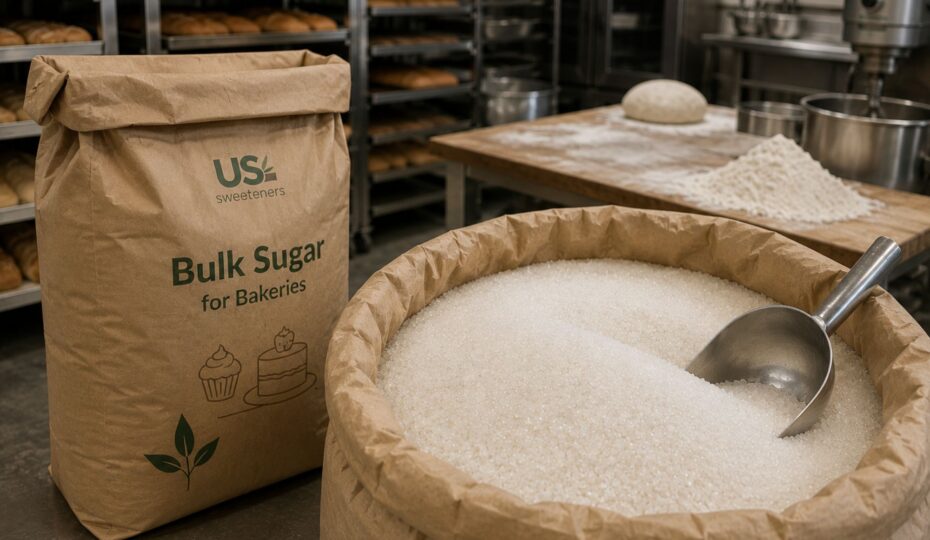
Packaging format directly affects labor handling, batching speed, warehouse movement, and ingredient loading efficiency throughout commercial bakery operations. Small bakeries often continue using 50-lb bags because they allow flexible staging and simpler manual handling, while larger facilities increasingly transition toward supersacks, totes, or liquid sugar systems to reduce labor intensity.
In high-volume bakery systems, packaging decisions can influence production efficiency almost as much as ingredient specifications themselves. One regional bakery manufacturer reduced manual ingredient loading time substantially after switching from hand-loaded 50-lb bags to supersack unloading systems integrated directly into automated batching equipment. The sugar formulation remained identical, but labor efficiency and ingredient flow consistency improved across multiple production shifts.
| Packaging Format | Best Fit | Operational Impact |
| 50-lb bags | Small to mid-sized bakeries | Flexible staging and manual handling |
| Palletized bags | Medium production facilities | Improved inventory movement |
| Supersacks | High-volume bakery systems | Reduced labor handling and downtime |
| Bulk totes | Automated batching systems | Faster ingredient loading |
| Liquid sugar systems | Continuous production lines | Reduced dust and dry handling |
Packaging also affects freight efficiency, warehouse utilization, and ingredient damage risk. Larger packaging formats typically improve pallet density and reduce packaging waste, but they also require compatible unloading equipment and stronger inventory coordination. Procurement teams often evaluate labor savings, warehouse layout, and production speed together before changing packaging formats.
How Commercial Bakeries Evaluate Sugar Suppliers
Commercial bakery procurement teams typically evaluate suppliers based on inventory reliability, warehouse coverage, freight coordination, packaging flexibility, and operational responsiveness rather than focusing only on commodity pricing.
This becomes especially important before seasonal production peaks. Bakeries producing holiday cookies, pastries, or decorated bakery products may require faster replenishment access to palletized sugar, powdered sugar, brown sugar, or sanding sugar without relying on one warehouse origin. Multi-warehouse suppliers help reduce replenishment risk by shortening freight lanes and providing alternate inventory points during regional delays or transportation bottlenecks.
Reliable commercial sugar suppliers should also provide specification consistency across multiple shipments. Even minor differences in granulation, moisture content, or packaging integrity can affect production stability at scale. Bakery procurement and R&D teams often evaluate supplier performance using measurable operational indicators such as:
- On-time delivery rates
- Lot consistency
- Packaging integrity
- Freight responsiveness
- Emergency replenishment support
US Sweeteners supports bakery procurement teams with bulk sugar sourcing, flexible packaging formats, multi-warehouse fulfillment, and delivery coordination designed for commercial bakery production environments. Suppliers capable of supporting long-term operational growth often become valuable partners during expansion, seasonal scaling, or product reformulation initiatives.
Why Bakeries Continue Choosing US Sweeteners
Commercial bakeries need ingredient suppliers capable of supporting operational consistency, inventory stability, and production scalability across changing market conditions. Delayed shipments, damaged packaging, or inconsistent sugar granulation can disrupt production schedules and increase waste throughout bakery systems.
US Sweeteners supplies granulated sugar, powdered sugar, cane sugar, brown sugar, specialty sugars, and liquid sugar products to bakeries, wholesalers, and food manufacturers across the United States. The company supports flexible order formats including 50-lb bags, palletized shipments, and bulk packaging options designed for commercial ingredient handling environments.
With more than 30 years of logistics experience, US Sweeteners helps bakery procurement teams coordinate ingredient sourcing around production schedules, freight planning, and operational requirements. Bakeries looking for wholesale bakery sugar or long-term bakery ingredient sourcing support can request product specifications, packaging details, and delivery information directly from US Sweeteners.
Conclusion
Choosing the right bulk sugar for bakeries involves much more than selecting a sweetness source. Commercial bakeries must evaluate granulation, moisture sensitivity, packaging efficiency, ingredient flow behavior, and supplier reliability to maintain consistent production performance at scale. Different sugar grades perform differently across cookies, laminated doughs, meringues, cake systems, icings, and decorative bakery applications. Matching sugar specifications to product requirements helps bakery procurement and R&D teams improve texture consistency, depositor performance, batching efficiency, and shelf stability while reducing operational disruptions.
US Sweeteners supplies bulk sugar, specialty sugars, powdered sugar, cane sugar, and liquid sweeteners to bakeries, wholesalers, and food manufacturers throughout the United States. Contact us today to request bulk sugar pricing and explore supply solutions designed for commercial bakery production.
FAQs
What sugar granulation works best for commercial cookie production?
Medium granulated sugar is commonly used in commercial cookie systems because it helps control spread, texture, and browning consistency during baking. Finer granulations may dissolve more rapidly and affect finished texture or bake behavior. Many bakery R&D teams test granulation carefully during formulation optimization because even small crystal differences can affect production performance at scale.
Why do bakeries use extra-fine sugar in meringues?
Extra fine sugar dissolves rapidly during whipping, which helps stabilize foam structure and reduce graininess in meringues and whipped bakery systems. Faster dissolution also supports smoother texture and better aeration in sponge cake production. Commercial bakeries often use extra-fine sugar in products where stable foam development directly affects the finished structure.
How can bakeries reduce sugar caking during storage?
Commercial bakeries reduce caking risk by storing sugar in cool, dry environments and maintaining sealed packaging until production use. Humidity control, pallet rotation, and proper warehouse handling also help reduce moisture exposure during long-term storage. Powdered sugar and brown sugar typically require additional monitoring because they absorb moisture more quickly than standard white granulated sugar.
What packaging format works best for high-volume bakeries?
High-volume bakery systems often use supersacks, totes, or liquid sugar systems because these formats reduce labor handling and improve batching efficiency. Smaller bakeries may still prefer 50-lb bags for flexibility and easier staging. The best packaging format depends on production volume, automation level, warehouse infrastructure, and ingredient handling systems.

Thomas is a product expert at US Sweeteners, a trusted bulk sugar and sweetener distributor serving food and beverage manufacturers across the USA. He writes about sweetener sourcing, ingredient trends, and supply chain insights for the food industry.