
The U.S. refined cane sugar market reached $7.8 billion in 2025, with 79% of that volume flowing directly into food and beverage manufacturing. Yet despite this dominance, many product developers still treat cane sugar as interchangeable with beet sugar or other sweeteners. That assumption costs real money at scale. Understanding the physical structure, refining process, functional types, and application-specific performance of cane sugar is not optional for serious formulators. It is the foundation of consistent, shelf-stable, high-quality products in beverages and desserts.
Table of Contents
- Cane sugar basics: What it is and how it’s made
- Types of cane sugar and their functional properties
- Cane sugar performance: Beverages and dessert formulation insights
- Market relevance: Global trends and food industry benchmarks
- Why formulation details matter more than you think
- Where to source quality cane sugar in bulk
- Frequently asked questions
Key Takeaways
| Point | Details |
|---|---|
| Cane sugar origin and process | Cane sugar comes from sugarcane and is refined through a multi-step industrial process for high purity. |
| Diverse types and uses | Granulated, brown, and other forms each impact product characteristics in unique ways. |
| Superior performance | Cane sugar dissolves quickly and enhances texture and flavor in beverages and baked goods. |
| Market dominance | Cane sugar is the leading choice for US and global food and beverage manufacturing. |
| Trial essential for precision | Testing cane sugar types is vital since small differences may affect product consistency and quality. |
Cane sugar basics: What it is and how it’s made
Cane sugar is sucrose from sugarcane (Saccharum officinarum), a tropical grass cultivated across subtropical and tropical regions. That source distinction matters technically. Beet sugar is chemically identical in terms of sucrose content, but the two differ in crystal morphology, trace compound profiles, and processing behavior. When you are formulating at scale, those differences show up in dissolution rates, caramelization behavior, and texture.
The industrial production process moves through seven defined stages:
- Harvesting: Mature cane stalks are cut and transported to the mill within hours to prevent sucrose degradation.
- Crushing: Stalks are pressed to extract raw juice, which contains sucrose, water, fiber, and impurities.
- Clarification: Lime and heat are used to precipitate non-sugar solids, producing a cleaner juice.
- Evaporation: Water is removed under vacuum to concentrate the juice into a thick syrup.
- Crystallization: Controlled cooling and seeding cause sucrose crystals to form from the syrup.
- Refining: Raw crystals are washed, re-dissolved, filtered, and re-crystallized to increase purity.
- Drying: Final crystals are dried and screened to achieve consistent particle size for packaging.
A common misconception in procurement is that “raw” cane sugar is unprocessed. It is not. Raw cane sugar has gone through clarification and crystallization. It simply has not been fully refined to remove residual molasses. That molasses content is what gives turbinado and demerara their characteristic color and flavor.
| Property | Cane sugar | Beet sugar |
|---|---|---|
| Source plant | Saccharum officinarum | Beta vulgaris |
| Crystal shape | Monoclinic, uniform | Irregular, variable |
| Trace compounds | Minimal molasses residue | Different amino acid profile |
| Refining behavior | Predictable, consistent | Can vary by crop season |
| Caramelization onset | ~160°C | ~160°C (similar) |
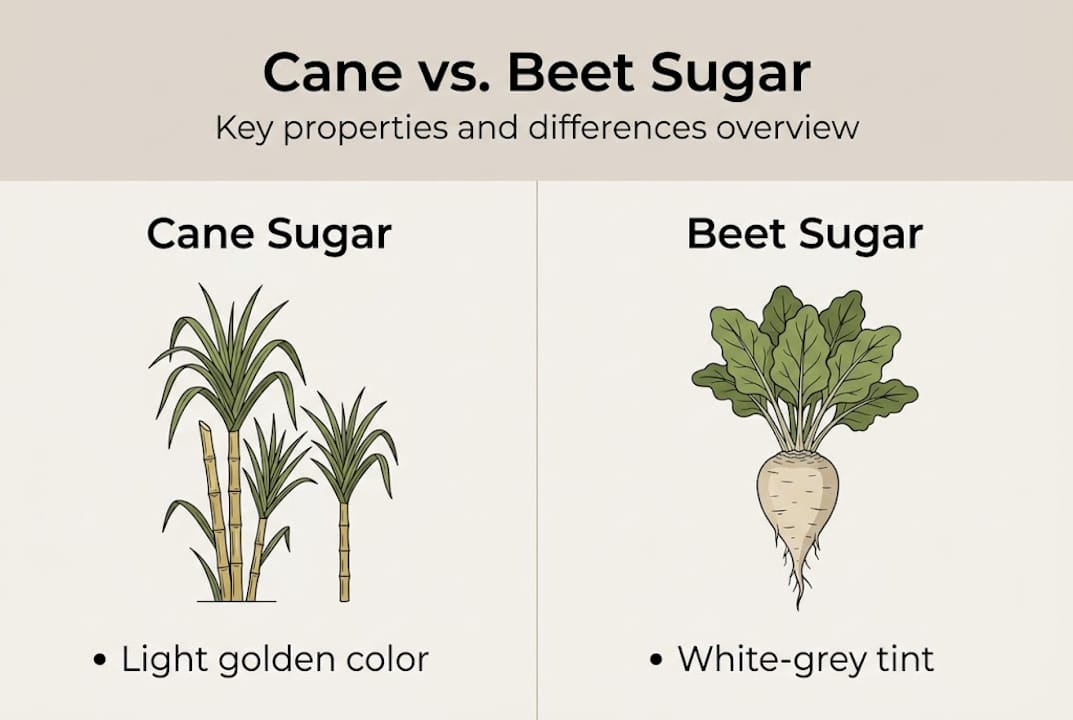
For a deeper technical comparison, see our breakdown of cane sugar vs. beet sugar behavior in formulation. When sourcing for specific applications, the bulk cane sugar forms available to manufacturers range from granulated white to liquid, each suited to different processing lines.
Pro Tip: Always request a certificate of analysis specifying crystal size distribution, moisture content, and ash levels when evaluating a new cane sugar supplier. These parameters directly affect how your product behaves in mixing and baking.
Types of cane sugar and their functional properties
Not all cane sugar performs the same way in your formulation. The form you choose determines texture, color development, moisture retention, and flavor complexity. Refined cane sugar is 99.95% sucrose, but less refined forms retain molasses, and that molasses changes everything from hygroscopicity to Maillard reaction intensity.
Here is how the major forms compare for manufacturing applications:
| Sugar type | Sucrose % | Molasses content | Best application |
|---|---|---|---|
| Granulated white | 99.95% | None | Beverages, bakery, confectionery |
| Caster (superfine) | 99.9% | None | Meringues, fine-texture cakes |
| Powdered (10x) | ~99% | None | Frostings, fondants, coatings |
| Turbinado | ~96% | Low | Specialty beverages, toppings |
| Demerara | ~96% | Low | Syrups, artisan baked goods |
| Brown (light/dark) | 91-96% | Medium to high | Cookies, sauces, marinades |
| Muscovado | 89-95% | High | Robust flavor applications |
Molasses content drives two critical functional effects. First, it increases hygroscopicity, meaning the sugar absorbs and retains moisture. This is useful in soft cookies and moist cakes but problematic in hard candies or dry mixes. Second, it intensifies Maillard browning and caramel notes, which can be a design feature or a defect depending on your target flavor profile.
For applications where you need precise color control, such as clear sodas or white fondant, granulated or caster grades are the only viable options. For a product requiring rich molasses depth, muscovado or dark brown cane sugar delivers without the need for added flavor compounds. Understanding the cane sugar vs. brown sugar differences helps formulators avoid costly mid-run corrections.
- Granulated: Standard workhorse for most beverage and bakery lines.
- Caster: Dissolves faster than standard granulated, ideal for cold-process applications.
- Powdered: Requires anti-caking agents in humid environments; check for cornstarch additions if allergen labeling matters.
- Brown/muscovado: Clumping is common in storage; specify moisture barriers in packaging specs.
For a full technical overview of less processed options, the raw cane sugar guide covers sourcing and application nuances in detail.
Cane sugar performance: Beverages and dessert formulation insights
When you move from ingredient selection to actual formulation, cane sugar’s performance advantages become measurable. Cane sugar dissolves 21% faster than beet sugar in cold water, which is a significant operational advantage for cold-fill beverage lines where heat is not part of the process. Faster dissolution means fewer undissolved particles, cleaner mouthfeel, and more consistent Brix readings across batches.
In baked goods, crystal structure drives aeration. Cane sugar’s uniform monoclinic crystals create more consistent air pockets during creaming, resulting in 14% higher rise in cakes and crisper cookie texture compared to beet sugar alternatives. For caramels, meringues, and fondants, this crystal consistency is not a minor variable. It is the difference between a batch that sets correctly and one that grains or weeps.
Here is a practical performance reference for common applications:
| Application | Recommended form | Key performance factor |
|---|---|---|
| Cold-fill sodas/syrups | Granulated or liquid cane | Fast dissolution, clear sweetness |
| Hot-process beverages | Granulated white | Predictable Brix, no off-notes |
| Meringues | Caster | Fine crystal for stable foam |
| Caramels | Granulated white | Consistent crystal for even melt |
| Fondants | Powdered | Smooth texture, no graininess |
| Moist cakes/brownies | Brown or muscovado | Moisture retention, color depth |
- Test dissolution at your process temperature. Cold-fill lines behave differently from hot-fill. Run dissolution trials at actual production temperatures, not lab ambient.
- Monitor Brix in real time. Switching sugar sources mid-run without recalibration causes batch inconsistency.
- Account for molasses in color specs. Brown sugar grades shift color values measurably. Update your color tolerances before switching grades.
- Check crystal size distribution. Finer crystals aerate better but dissolve differently in dry mix applications.
Stat callout: Cane sugar’s 21% faster cold-water dissolution rate directly reduces mixing time on cold-fill beverage lines, cutting energy costs and improving throughput consistency.
For operations moving toward liquid formats, the benefits of liquid cane sugar include easier dosing, no dissolution step, and reduced risk of particulate contamination in high-clarity beverages. Liquid formats also simplify CIP (clean-in-place) protocols on automated lines.
Pro Tip: For caramel and confectionery applications, use only fully refined granulated cane sugar with a defined crystal size range. Trace minerals in less refined grades can act as nucleation sites, causing premature crystallization in your finished product.
Market relevance: Global trends and food industry benchmarks
Understanding where cane sugar sits in the broader market helps procurement teams make smarter sourcing decisions and gives R&D teams context for ingredient availability and pricing trends.
The numbers are substantial. The U.S. refined cane sugar market is $7.8 billion in 2025, with 78% of volume in white grade and 79% of total consumption going to food and beverage manufacturers. Globally, the market sits at $61 billion, with 84% in crystallized form. These figures reflect cane sugar’s position not as a commodity afterthought but as a primary functional ingredient with deep supply chain infrastructure.
| Market segment | Value/share |
|---|---|
| U.S. refined cane sugar market (2025) | $7.8 billion |
| White grade share (U.S.) | 78% |
| Food and beverage use (U.S.) | 79% |
| Global cane sugar market | $61 billion |
| Crystallized form (global) | 84% |
“Food and beverage manufacturers account for nearly four out of five pounds of refined cane sugar consumed in the United States. That concentration signals both the ingredient’s irreplaceability and the supply chain pressure that comes with it.”
For procurement teams, these benchmarks carry real implications:
- White grade dominance means supply is deep, but specialty grades (turbinado, muscovado) can tighten seasonally. Plan specialty grade procurement 60 to 90 days ahead.
- Global crystallized form preference (84%) reflects the logistics advantages of dry sugar over liquid. Liquid formats are growing but remain a smaller share.
- Food and bev concentration means pricing is sensitive to crop yields in Brazil, India, and Thailand, the three largest cane-producing nations. Diversified sourcing reduces exposure.
For manufacturers evaluating their ingredient supply, the full range of sweetener market offerings covers both standard and specialty cane grades. For high-volume operations, bulk raw cane sugar sourcing options are available with flexible logistics to match production schedules.
Why formulation details matter more than you think
Here is the uncomfortable truth most ingredient guides skip: the assumption that “sugar is sugar” is one of the most expensive mistakes a food manufacturer can make at scale. Crystal morphology is not a theoretical concern. In high-precision applications like macarons or crème brûlée, beet substitution causes 12 to 29% variance in spread, rise, and dissolution due to crystal structure differences alone.
That variance does not just affect taste. It affects yield, waste, and rework costs on every production run. We have seen formulators spend months troubleshooting texture inconsistencies that traced back to a mid-year supplier switch from cane to beet sugar. The fix was not a new recipe. It was returning to the original ingredient specification.
The practical takeaway is this: before any full-scale run with a new cane sugar source or grade, run empirical trials in your actual processing environment. Lab conditions do not replicate production line temperatures, mixing speeds, or humidity. Your test kitchen should evaluate differences for precision uses under real conditions, not assumed equivalence. Document the results. Build them into your ingredient specifications. That discipline is what separates consistent brands from inconsistent ones.
Where to source quality cane sugar in bulk
Knowing which cane sugar grade your formulation needs is only half the equation. The other half is reliable, high-volume supply with consistent specifications batch over batch.
As a dedicated US cane sugar supplier with nearly two decades of experience, US Sweeteners stocks granulated, brown, turbinado, demerara, muscovado, and bulk liquid cane sugar formats ready for large-scale orders. Our multiple warehouse locations support fast delivery across North America, and our private labeling options give you flexibility in packaging. Whether you are scaling a new beverage line or optimizing a dessert formulation, our team works directly with sweeteners for ingredient manufacturing at every volume level. Contact us to match the right grade to your next production run.
Frequently asked questions
How does cane sugar differ from beet sugar in formulation?
Cane sugar has a distinct crystal structure and trace molasses profile that produces 21% faster dissolution in cold water, making it more reliable in beverage and baked good applications where consistency is critical.
What are the main types of cane sugar used in food manufacturing?
Manufacturers most often use granulated, brown, turbinado, demerara, muscovado, caster, and powdered cane sugar. Each form has a distinct sucrose and molasses content level that drives different functional outcomes in texture, color, and moisture retention.
Why choose cane sugar over other sweeteners in beverages?
Cane sugar offers rapid, clean-tasting sweetness with no off-notes, and its faster cold-water dissolution makes it the preferred choice for sodas, syrups, and cold-fill lines where heat is not used to aid mixing.
How large is the cane sugar market for the food industry?
In the U.S., 79% of refined cane sugar goes to food and beverage use, with a market size of $7.8 billion in 2025, reflecting its central role as a primary functional ingredient across the sector.
Recommended
- What is Liquid Cane Sugar: Benefits and Uses – US Sweeteners
- Is Cane Sugar Refined? Process and Benefits Explained – US Sweeteners
- Raw Cane Sugar: Ultimate Guide for Bulk Buyers – US Sweeteners
- Is Organic Cane Sugar Healthy? Benefits & Facts – US Sweeteners
- Smoked simple syrup is delicious and well, simple