

Switching from sucrose to an alternative sweetener sounds straightforward on paper. In practice, it’s one of the most technically demanding reformulation challenges in food manufacturing. Off-notes surface during pilot runs, consumer panels flag unfamiliar aftertastes, and products that performed well in model solutions fall apart in the final matrix. The problem isn’t the sweetener itself. It’s the assumption that sweetness is a single, interchangeable variable. Sweeteners differ at the receptor level, in their temporal behavior, and in how they interact with every other flavor compound in your system. Understanding those mechanisms is the first step toward solving them.
Table of Contents
- How sweeteners interact with taste receptors
- Temporal profiles and off-taste generation: Why not all sweetness is equal
- Beyond sweetness: Multidimensional impacts on flavor profile
- Blending and modulation strategies: Achieving target profiles
- Why fixing sweetener flavor profiles is harder than it looks
- Unlock better flavor profiles with the right sweetener solutions
- Frequently asked questions
Key Takeaways
| Point | Details |
|---|---|
| Sweetener binding differences | Each sweetener interacts with taste receptors uniquely, leading to different onset, intensity, and duration. |
| Off-tastes and linger | High-intensity sweeteners often produce unwanted aftertastes and longer linger compared to sucrose. |
| Flavor balance disruption | Replacing sugar can unbalance the profile by failing to suppress bitterness and altering mouthfeel. |
| Blending strategies matter | Custom blends and modulation techniques can improve sensory profiles but must be tailored to each product. |
How sweeteners interact with taste receptors
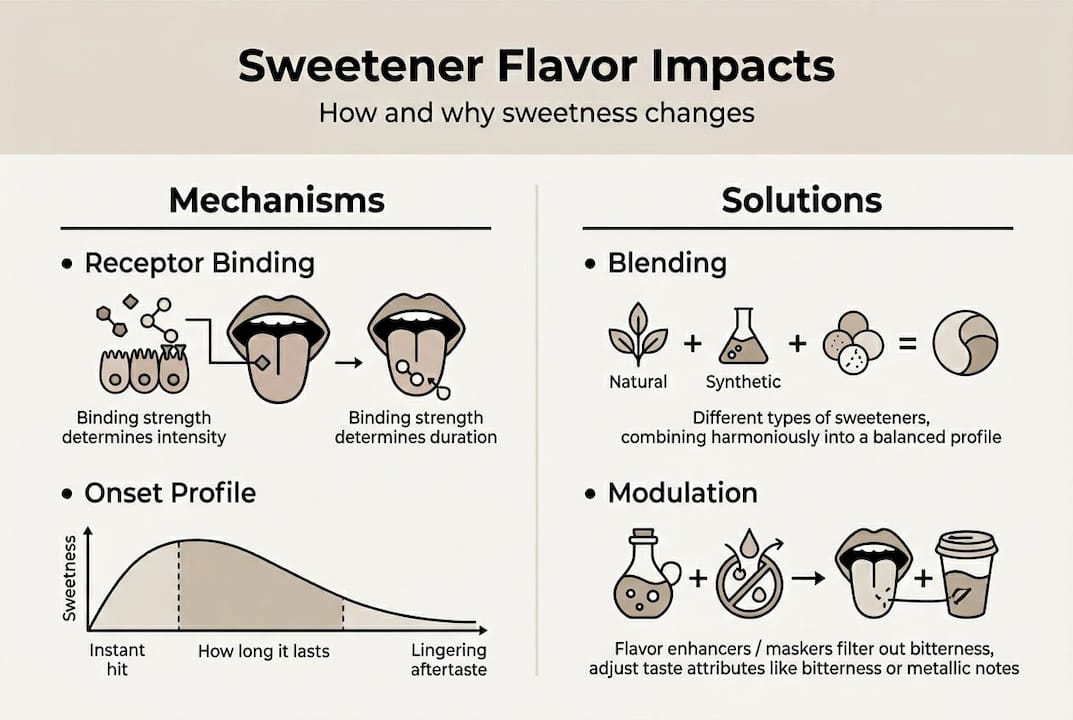
Every sweetener you use, whether sucrose, aspartame, sucralose, or steviol glycosides, activates the T1R2/T1R3 sweet taste receptor heterodimer. But activation is not uniform. Multiple sweeteners activate sweet taste through different receptor sites, primarily at the Venus flytrap domain (VFT) of TAS1R2, inducing a clamshell closure and conformational changes that trigger downstream signaling. The critical detail: different sweeteners bind variably, which produces distinct temporal profiles in perceived sweetness.
This is why two products with identical Brix readings can taste completely different. Sucrose binds quickly and releases cleanly. High-intensity sweeteners (HIS) often bind at multiple or overlapping sites, producing slower onset and prolonged receptor activation. Research on distinct binding sites for sweeteners confirms that these molecular differences are not minor variations. They fundamentally alter how the brain processes sweetness over time.
| Sweetener | Binding site | Onset speed | Linger | Off-target activation |
|---|---|---|---|---|
| Sucrose | VFT domain, TAS1R2 | Fast | Minimal | Low |
| Aspartame | VFT domain, TAS1R2 | Moderate | Moderate | Low |
| Sucralose | VFT + transmembrane | Fast | High | Moderate |
| Stevia (Reb A) | VFT domain, TAS1R2 | Slow | Very high | High (bitter receptors) |
Why does this matter for your formulations?
- Onset mismatch means the product’s sweetness peak arrives at the wrong moment in the flavor sequence, disrupting the expected taste arc.
- Prolonged linger creates a sweetness tail that competes with aftertaste notes or masks finish flavors you want consumers to notice.
- Off-target receptor activation, particularly of bitter TAS2R receptors, introduces off-notes that no amount of flavor masking fully eliminates.
- Intensity scaling differs from sucrose, so concentration adjustments don’t produce linear taste results.
For teams working on sweetener blends for manufacturing, understanding these binding dynamics is the foundation for every downstream formulation decision. You can’t correct what you haven’t identified at the molecular level.
“The assumption that sweeteners are functionally interchangeable with sucrose at equivalent sweetness levels consistently underestimates the downstream sensory consequences in complex food matrices.” This is the core insight driving current reformulation research across the industry.
Temporal profiles and off-taste generation: Why not all sweetness is equal
With a foundational understanding of taste receptor interactions, we can now explore why the experience of sweetness itself diverges so much between sweeteners. Timing is everything in sensory perception, and HIS consistently deviate from sucrose’s clean temporal profile.
Temporal sensory analysis of sweeteners shows that sucralose, aspartame, acesulfame-K, and stevia all exhibit delayed onset, prolonged linger, and side tastes including bitter, metallic, and chemical notes. In practical terms, sweetness linger can extend up to 2x longer for certain HIS compared to sucrose, which directly affects how consumers perceive the finish of a beverage or confection.

| Sweetener | Onset | Duration | Side-taste prevalence |
|---|---|---|---|
| Sucrose | Immediate | Short, clean | Very low |
| Aspartame | Slight delay | Moderate | Low to moderate |
| Acesulfame-K | Moderate delay | Long | Moderate (bitter) |
| Sucralose | Fast | Very long | Moderate (chemical) |
| Stevia (Reb A) | Slow | Very long | High (bitter, licorice) |
Common off-tastes and their sources break down as follows. Bitterness in stevia and acesulfame-K traces back to activation of TAS2R bitter receptors, a separate receptor class from T1R2/T1R3. Metallic notes in saccharin and some stevia extracts are linked to sulfonate and lactone structures interacting with oral epithelial proteins. Chemical or artificial notes in sucralose are associated with chlorinated sugar structures that activate trigeminal nerve endings in addition to taste receptors. Understanding the aftertaste mechanisms behind each sweetener class helps you choose the right starting point for your system.
A structured sensory evaluation protocol for HIS products should follow these steps:
- Establish a sucrose reference standard at target sweetness equivalence.
- Evaluate each HIS candidate in a neutral aqueous solution first to isolate receptor-level behavior.
- Conduct time-intensity (TI) or temporal dominance of sensations (TDS) testing to map onset, peak, and linger.
- Screen for off-tastes at the pilot scale in the actual product matrix, not just model solutions.
- Run consumer panels at 48 and 72 hours post-production to capture any off-note development from matrix interactions.
Pro Tip: Always screen products for delayed off-tastes in pilot-scale runs. Off-notes from HIS can intensify after heat treatment or during shelf aging, making early-stage model solution data unreliable for final product decisions.
For sweeteners used in flavor enhancement applications, temporal profiling isn’t optional. It’s the difference between a product that passes panel and one that fails at retail.
Beyond sweetness: Multidimensional impacts on flavor profile
Building on timing and off-tastes, it’s crucial to realize that sweetness is only one dimension. Sweeteners can shift the entire sensory experience across multiple taste modalities simultaneously.
Sucrose does far more than add sweetness. Sugar’s influence on multimodal taste confirms that it suppresses bitterness, sourness, and saltiness through chemical, physiological, and cognitive interactions. It also enhances flavor intensity, improves flavor delivery, and increases viscosity and mouthfeel. HIS lack these properties, which is why sugar-reduced products frequently present with unbalanced profiles, excessive sourness, thin mouthfeel, and a general loss of flavor complexity.
Key side effects vary by matrix:
- Soft drinks: Acidity becomes more pronounced without sucrose’s buffering effect, making citric acid taste sharper and more aggressive.
- Protein beverages: Astringency increases when HIS fail to suppress the inherent bitterness of whey or plant proteins.
- Dairy products: Mouthfeel becomes noticeably thinner, and flavor release timing shifts, making top notes more volatile and less integrated.
- Bakery goods: Caramelization and Maillard reaction contributions from sucrose are absent, removing depth and color that consumers associate with quality.
The activation of bitter receptors by HIS is strongly matrix-dependent. In acidic environments, bitterness from stevia and acesulfame-K intensifies. In protein-rich systems, the interaction between HIS and protein-bound bitter compounds amplifies off-notes further.
“In full-sugar versus sugar-reduced comparisons, bitterness and sourness dominance consistently emerge as the leading drivers of consumer rejection in reduced-sugar products, regardless of sweetener type used.”
Pro Tip: Consider using pre-blending, positive allosteric modulators (PAMs), or flavor-modifying proteins (FMPs) to restore balance. These tools don’t add sweetness, but they recalibrate how your receptor system processes the entire flavor signal. For applications where sweeteners affect texture, addressing mouthfeel loss is as important as managing off-tastes.
Blending and modulation strategies: Achieving target profiles
Understanding complexity opens the door to practical tactics. Blending and modulation offer viable pathways for industry application when executed with matrix-specific precision.
Blending strategies for sweetener optimization show that aspartame combined with acesulfame-K produces the closest match to sucrose in lingonberry nectar, reducing acidity, astringency, and pungency simultaneously. In ice cream, blending Reb A with Reb D or Reb M significantly reduces stevia’s characteristic bitterness. These results aren’t transferable across matrices without retesting, but they demonstrate the principle: no single HIS performs optimally alone.
| Blend | Effect on taste | Effect on mouthfeel | Best matrix |
|---|---|---|---|
| Aspartame + Acesulfame-K | Reduces linger, balances onset | Neutral | RTD beverages, dairy |
| Reb A + Reb D/M | Reduces bitterness, cleaner finish | Slight improvement | Ice cream, dairy |
| Sucralose + Erythritol | Masks chemical notes, adds body | Improved | Bakery, confections |
| Stevia + Monk fruit | Reduces licorice note, smoother | Moderate improvement | Beverages, sauces |
For sweeteners used in baking mixes, erythritol blends are particularly effective because they contribute cooling effect and bulk while moderating sucralose’s chemical character. For bulk ingredient sweeteners used across multiple applications, establishing a core blend library with tested matrices saves significant reformulation time.
PAMs work by binding to allosteric sites on the T1R2/T1R3 receptor, amplifying the response to existing sweeteners without adding sweetness themselves. This allows you to reduce total HIS concentration, which directly reduces off-taste intensity. FMPs work differently, modifying how bitter and sour signals are processed before they reach conscious perception. Combining these with sweetness enhancement strategies gives your R&D team a layered toolkit rather than a single lever.
Evidence-based protocol for developing new sweetener systems:
- Define target sweetness profile using sucrose as the benchmark, including onset, peak, and finish.
- Select candidate sweeteners based on receptor binding data and known temporal profiles.
- Build initial blends at 50/50, 70/30, and 30/70 ratios and evaluate in neutral solution.
- Introduce PAMs or FMPs at 0.1 to 0.5% levels and retest in model solution.
- Transfer best-performing candidates to the final product matrix and run full sensory panel.
- Iterate based on matrix-specific feedback before scaling.
Pro Tip: Always evaluate blends in the final matrix, not just model solutions. Protein, fat, fiber, and pH all interact with sweetener molecules in ways that model solutions cannot replicate.
Why fixing sweetener flavor profiles is harder than it looks
With practical approaches in hand, it’s important to consider why this remains a moving target rather than a solved equation. After working across dozens of food and beverage categories, one pattern is clear: the tools exist, but the application window is narrower than most developers expect.
What works in a juice blend fails in a dairy application. What performs well in a neutral beverage falls apart in a high-acid sauce. Matrix effects aren’t just variables to account for. They’re multipliers that can amplify off-notes by an order of magnitude. Population-level differences in bitter receptor sensitivity (TAS2R38 polymorphisms are well documented) mean that a product passing internal panels may still generate off-note complaints from 15 to 25% of your consumer base.
Regulatory limits on PAM and FMP usage add another constraint. You may identify the ideal modulation strategy in the lab and then find that approved usage levels don’t deliver the effect at scale. Mechanisms of sweetener aftertastes research makes clear that blends, PAMs, and FMPs offer real solutions, but they require matrix-specific optimization that doesn’t generalize cleanly across product lines.
The most common mistake we see is treating sweetener substitution as a one-time formulation event. It’s an ongoing process. Consumer preferences for sweetness quality are shifting, with younger demographics showing lower tolerance for detectable off-notes. For teams developing beverage sweetener solutions, this means building sensory re-evaluation cycles into your product roadmap, not just your initial launch process.
Unlock better flavor profiles with the right sweetener solutions
For teams ready to overcome the flavor challenges described above, reliable ingredient sourcing and technical support are crucial first steps.
US Sweeteners supplies a curated range of sweeteners for better flavor across every food and beverage matrix, from RTD beverages and dairy to bakery and confections. Our inventory includes both single-source sweeteners and pre-evaluated blend options, backed by nearly two decades of formulation-focused supply experience. Whether you’re sourcing bulk sweeteners for large-scale production or need targeted options for ingredient manufacturing, our technical sales team can help you match the right sweetener system to your specific matrix and flavor targets. Reach out to discuss your current reformulation challenges.
Frequently asked questions
Why do some sweeteners leave a bitter or metallic aftertaste?
Many HIS activate bitter receptors (TAS2Rs) alongside sweet receptors, generating off-notes that persist well after the sweetness peak fades. The intensity of these off-notes depends on both the sweetener’s molecular structure and the product matrix.
Can blending sweeteners really solve aftertaste issues?
Blending strategies for sweetener optimization confirm that well-chosen blends can significantly reduce off-tastes and produce sweetness profiles closer to sucrose. However, blend performance is matrix-specific and must be validated in the actual product, not model solutions.
Why is mouthfeel often different when using sweeteners instead of sugar?
Sugar’s influence on multimodal taste includes increasing viscosity and richness, properties that most HIS simply don’t replicate. The result is a thinner mouthfeel and reduced flavor complexity that consumers notice even when sweetness levels are matched.
Do sweeteners affect different products in different ways?
Yes, and the variation is significant. HIS bitterness becomes more pronounced in acidic or protein-rich matrices, meaning a sweetener that performs acceptably in a neutral beverage may generate strong off-notes in a high-acid drink or a protein shake. Always validate in the intended matrix.