

A single late sweetener delivery can stall an entire production run, force costly reformulations, and erode customer trust in ways that take months to repair. For U.S. food and beverage manufacturers, sweetener sourcing is not a background task — it is a critical operational lever. The U.S. sweetener supply is shaped by domestic harvests, import quotas, geopolitical pressures, and weather events, all of which can shift without warning. This guide walks you through four practical stages: mapping the supply chain, preparing your procurement toolkit, optimizing logistics, and troubleshooting disruptions, so you can build a sourcing strategy that holds up under real-world pressure.
Table of Contents
- Map the sweetener supply chain: Understanding the landscape
- Prepare for procurement: Tools, specs, and supplier selection
- Optimize logistics: Managing deliveries, inventory, and contracts
- Troubleshoot and verify: Managing risks and edge cases
- Expert perspective: Building true resilience in your sweetener supply chain
- Bulk sweetener solutions for reliable food manufacturing
- Frequently asked questions
Key Takeaways
| Point | Details |
|---|---|
| Supply chain mapping | Know your sources, process flow, and potential risks to build a resilient sweetener supply chain. |
| Supplier selection essentials | Always check compliance, certifications, and landed costs when shortlisting bulk sweetener suppliers. |
| Logistics optimization | Use multi-warehouse and contract strategies for faster fulfillment and reduced disruption risks. |
| Risk management practices | Diversify sourcing, monitor market disruptions, and verify all certifications to prevent gap risks. |
| Expert insight | Focus on resilience and compliance rather than the lowest price to protect your food production. |
Map the sweetener supply chain: Understanding the landscape
Before you can optimize anything, you need to see the full picture. The U.S. sweetener supply chain is more layered than most manufacturers realize, and the risks are embedded at every level.
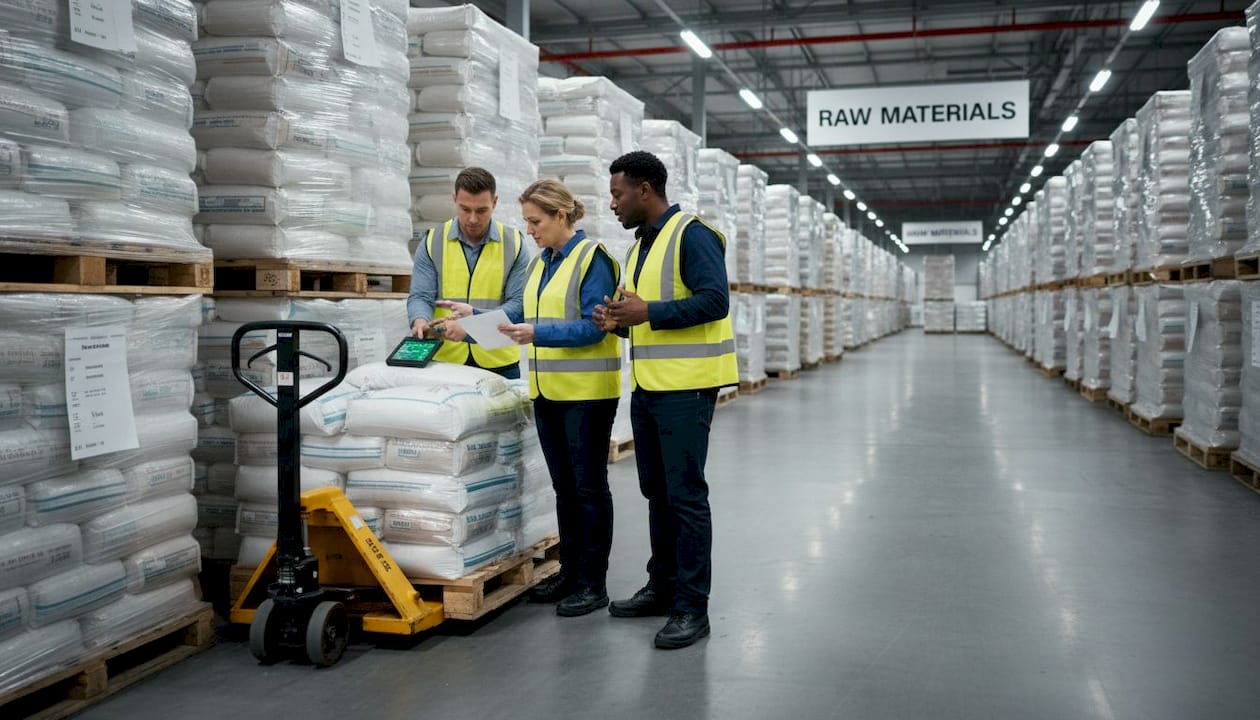
The 2025/26 U.S. sugar supply is forecast at 13.773 to 14.197 million short tons raw value (STRV), with food and beverage deliveries projected at 11.96 to 12.23 million STRV and an ending stocks-to-use ratio between 11.7% and 15.2%. Those numbers sound stable until you factor in that tight stocks-to-use ratios leave almost no buffer for weather events or import delays.
The supply chain itself flows through several key players:
- Domestic producers: Beet sugar processors (Upper Midwest, Pacific Northwest) and cane sugar mills (Florida, Louisiana, Texas)
- Importers: Sugar enters via tariff-rate quota (TRQ) and high-tier channels, with import volumes forecast between 2.235 and 2.475 million STRV for 2025/26
- Refiners and processors: Convert raw sugar into refined granulated, liquid, and specialty forms
- Distributors and bulk suppliers: Bridge the gap between large-scale production and F&B manufacturers
- Monitoring bodies: USDA Economic Research Service and FSA Sweetener Market Data (SMD) track supply flows in near real-time
Here is a quick snapshot of the main sweetener types and where supply risk concentrates:
| Sweetener | Primary source | Key risk factor |
|---|---|---|
| Sucrose (granulated) | Domestic beet/cane, imports | Weather, TRQ policy |
| High-fructose corn syrup (HFCS) | Domestic corn wet millers | Corn price volatility |
| Sucralose | Predominantly China | Geopolitical, trade policy |
| Dextrose | Domestic corn processors | Freight, seasonal demand |
| Liquid sucrose | Domestic refiners | Tanker availability |
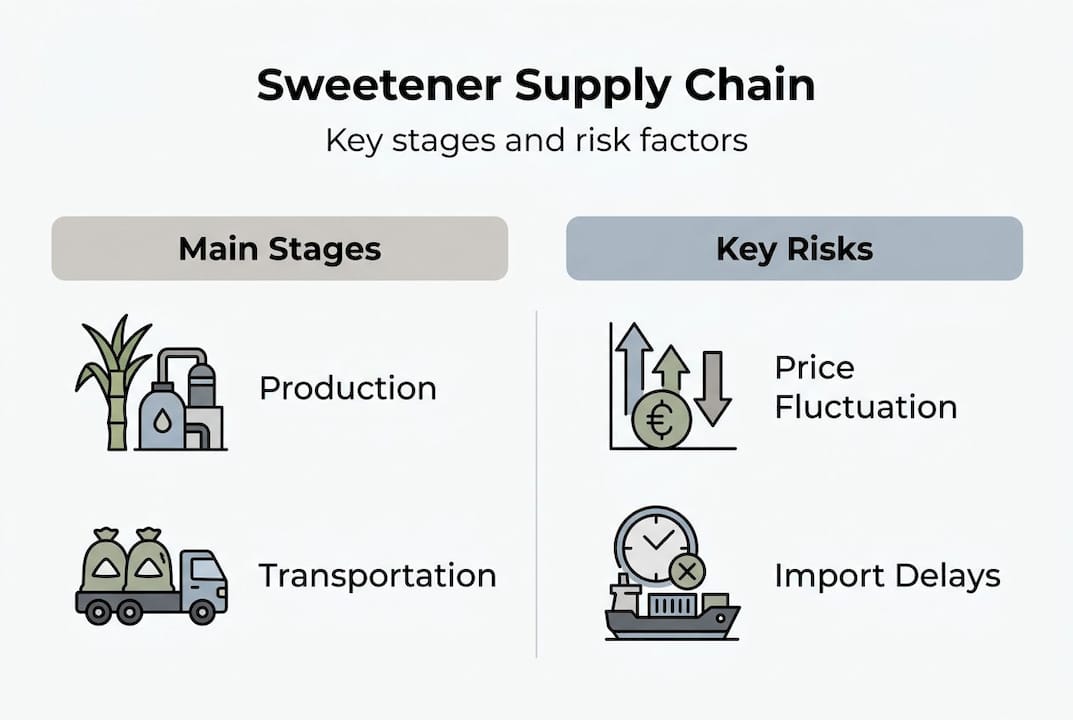
For a deeper look at how beet vs cane sugar differ in pricing and application, the distinction matters more than most buyers expect. You can also explore a broader sweetener sourcing overview to benchmark your current ingredient mix against available options.
The practical takeaway here is that no single node in this chain is immune to disruption. Domestic production can fall short in a drought year. Imports can stall at customs. Refinery capacity can tighten during peak demand seasons. Mapping these vulnerabilities is the first step toward managing them.
Prepare for procurement: Tools, specs, and supplier selection
With the supply chain mapped, you can now build a procurement framework that filters out weak suppliers before a disruption forces your hand.
Start with a specification checklist. Every sweetener you source should have defined parameters before you issue a purchase order:
- ICUMSA rating (color/purity standard for sucrose; ICUMSA 45 is standard refined white)
- Crystal size or viscosity depending on whether you are sourcing dry or liquid formats
- Origin declaration for labeling compliance and Non-GMO verification
- Moisture content and shelf-life requirements
- FDA 21 CFR 172 compliance for any functional sweetener additives
Once specs are defined, evaluate suppliers against compliance and logistics benchmarks. Bulk sweetener suppliers like US Sweeteners offer granulated sugar, liquid sucrose, HFCS, sucralose, and more with nationwide warehouse coverage and 1 to 2 day delivery windows, along with certificates of analysis (COAs) and certifications on request. That combination of speed and documentation is the baseline you should expect from any vetted partner.
Use a side-by-side comparison when shortlisting:
| Criteria | Tier 1 supplier | Tier 2 supplier |
|---|---|---|
| HACCP/FSMA certified | Required | Required |
| COA availability | On every lot | On request |
| Delivery lead time | 1 to 2 days | 3 to 5 days |
| Minimum order quantity | Flexible | Fixed pallet minimums |
| Dual-source capability | Yes | Limited |
A solid supplier selection methodology covers spec matching, HACCP and FSMA compliance verification, traceability documentation, and landed cost modeling that includes LTL (less-than-truckload) and FTL (full truckload) freight. Do not evaluate price in isolation. A supplier that is 3% cheaper but ships from a single warehouse with no backup inventory is a liability, not a savings.
For manufacturers sourcing for ingredient manufacturing, the compliance bar is even higher because your sweeteners become inputs for other manufacturers’ products. Staying ahead of 2026 sweetener sourcing trends can also help you anticipate demand shifts before they affect your contracts.
Pro Tip: Always dual-source your top two or three sweeteners. Qualifying a second supplier before you need them costs very little. Scrambling to find one during a supply gap costs a great deal.
Optimize logistics: Managing deliveries, inventory, and contracts
Supplier selection gets you to the starting line. Logistics execution is where supply chain resilience is actually built or lost.
Warehouse network design matters more than most buyers account for. A supplier with multi-warehouse logistics and 1 to 2 day U.S. delivery capability gives you a meaningful buffer against regional disruptions. A single-warehouse supplier, by contrast, creates a geographic chokepoint that weather or labor events can shut down entirely.
Bulk packaging formats each carry trade-offs you should weigh against your production setup:
- 25 lb and 50 lb bags: Flexible for smaller batch runs, easier to store, higher per-unit cost
- Supersacks (bulk totes, 1,500 to 2,000 lbs): Efficient for high-volume operations, reduce handling time
- Tanker deliveries (liquid sucrose, HFCS): Lowest cost per unit, requires dedicated receiving infrastructure
- Intermediate bulk containers (IBCs): Good middle ground for liquid sweeteners without tanker investment
Inventory strategy is the next lever. Just-in-time (JIT) sourcing keeps carrying costs low but leaves you exposed to any upstream delay. Safety stock (holding 2 to 4 weeks of buffer inventory for your highest-volume sweeteners) adds storage cost but dramatically reduces production risk. For imported sweeteners especially, port and customs delays can add 10 to 21 days without warning.
“Import-dependent sweetener categories carry inherent lead time uncertainty. Manufacturers who treat import timelines as fixed are the ones who get caught short.”
Contract structure also shapes your exposure. Recurring supply agreements lock in pricing and volume commitments, which protects you during tight markets. Spot purchasing offers flexibility but exposes you to price spikes. A blended approach — recurring contracts for your base volume, spot purchasing for surge needs — is the most practical model for most manufacturers.
For beverage production logistics specifically, liquid sweetener delivery scheduling and tanker turnaround times deserve their own standard operating procedures. Co-manufacturers managing multiple client formulations need even tighter inventory controls to avoid cross-contamination of supply allocations.
Pro Tip: Build your reorder point calculations around worst-case lead times, not average lead times. The average will not protect you when a geopolitical supply disruption adds three weeks to an import shipment.
Troubleshoot and verify: Managing risks and edge cases
Even well-designed supply chains encounter edge cases. Knowing where they hide lets you respond faster and with less damage.
The beet vs cane sourcing question is one that trips up buyers who treat sugar as a commodity. Beet sugar often carries pricing advantages and Non-GMO positioning, while cane sugar is preferred in certain confectionery and beverage formulations for flavor purity. Regulatory labeling requirements differ too, so your procurement team and your R&D team need to be aligned before you switch origins.
High-intensity sweeteners carry a different category of risk. Sucralose supply dynamics illustrate the problem clearly: sucralose is approximately 600 times sweeter than sugar, used in tiny quantities, but China accounts for roughly 80% of global production. That concentration means trade policy shifts or geopolitical events can tighten supply and spike prices with very little notice. The same concentration risk applies to other high-intensity alternatives sourced primarily from Asia.
Common disruption triggers to monitor:
- Weather events in Florida cane regions or Upper Midwest beet-growing areas
- Port congestion at major U.S. import terminals, particularly on the Gulf Coast
- Geopolitical escalation affecting shipping lanes, as seen with confectionery supply shortages linked to regional conflicts
- TRQ policy changes that alter available import volumes mid-year
- Refinery capacity constraints during peak demand periods (Q4 holiday season)
Verification steps should be built into your receiving process, not treated as an occasional audit:
“A COA that you never check is not a quality control tool. It is a paper trail.”
For every sweetener delivery, confirm lot-specific COA documentation, verify ICUMSA or purity specs against your purchase order, and check traceability back to the production facility. For functional additives, confirm FDA 21 CFR 172 compliance is current. These steps take minutes and prevent costly reformulation or recall scenarios.
Expert perspective: Building true resilience in your sweetener supply chain
Here is the uncomfortable truth most supply chain guides skip: the manufacturers who get hurt most during disruptions are not the ones who failed to plan. They are the ones who optimized exclusively for lowest unit cost and left no margin for error anywhere in the system.
Chasing the cheapest sweetener price is rational in isolation. But when that low-cost supplier has a single warehouse, sources 100% from imports, and offers no backup inventory commitment, you have traded resilience for a few cents per pound. When a disruption hits, those cents disappear instantly in expediting fees, production downtime, and lost customer orders.
The USDA-monitored domestic supply offers something imports cannot: transparency and regulatory oversight that makes supply forecasting more reliable. Prioritizing domestic sources for your core sweetener volumes, then using imports to fill specialty or cost-optimization gaps, is a more durable model than the reverse.
For high-intensity sweeteners with concentrated supply chains, the lesson from recent years is clear: multi-sourcing strategies are not a luxury. They are the minimum viable risk management posture. Qualifying two suppliers in different geographies for your sucralose or stevia needs before a disruption is the kind of preparation that pays for itself the first time you need it.
Bulk sweetener solutions for reliable food manufacturing
Building a resilient sweetener supply chain starts with partnering with suppliers who have the infrastructure to back up their commitments.
US Sweeteners has spent nearly two decades supplying bulk sugars and sweetening agents to bakeries, beverage producers, dairies, confectioners, and co-manufacturers across the United States. As a trusted bulk sugar supplier with nationwide warehouse coverage and rapid fulfillment, we carry the inventory depth and logistics capability your production schedule demands. Explore our full bulk sweetener selection to find the formats and specifications that match your formulations, or connect with our team through our ingredient manufacturing solutions page to discuss volume commitments, certifications, and custom packaging options.
Frequently asked questions
What is the most reliable sweetener supply source for U.S. food manufacturers?
USDA-monitored domestic supply offers the highest reliability for core sweetener volumes, while import sources carry greater exposure to delays and price volatility.
How can I prevent disruptions in my sweetener supply chain?
Diversify across at least two qualified suppliers, hold safety stock for your highest-volume ingredients, and track geopolitical developments that affect import lead times and port availability.
Which certifications should bulk sweetener suppliers have?
At minimum, look for HACCP and FSMA compliance, lot-specific COA documentation, and traceability records per the supplier selection benchmarks used by leading F&B manufacturers.
What is the difference between beet and cane sugar for bulk sourcing?
Beet sugar typically offers pricing advantages and Non-GMO positioning, while cane sugar is preferred in formulations where flavor purity and origin labeling are priorities.
How can I verify the quality and compliance of sweetener deliveries?
Review lot-specific COA certificates against your purchase order specs, confirm traceability to the production facility, and verify FDA 21 CFR 172 compliance for any functional sweetener additives on every receiving event.