
Not all sugar alternatives are created equal, and treating them like they are is one of the most costly mistakes a food or beverage manufacturer can make. From high-intensity sweeteners like stevia and monk fruit to sugar alcohols and rare sugars like allulose, each category brings a distinct functional profile, regulatory footprint, and consumer perception. The specialty sweetener landscape can feel overwhelming, especially as regulations tighten and clean-label demands grow louder. This guide breaks down what specialty sweeteners actually are, how the major categories compare, and what manufacturers need to know about formulation, compliance, and sourcing in 2026.
Table of Contents
- Defining specialty sweeteners: What sets them apart
- Major classes of specialty sweeteners: Features and use cases
- Regulatory and labeling considerations
- Managing taste challenges: Formulation strategies
- Market trends and buyer considerations for 2026
- A fresh perspective: Navigating complexity and making specialty sweeteners work for you
- Sourcing bulk specialty sweeteners: Your next step
- Frequently asked questions
Key Takeaways
| Point | Details |
|---|---|
| Specialty sweetener basics | These are sugar alternatives with specific benefits for calorie reduction and clean labeling in manufacturing. |
| Types and applications | They include high-intensity, sugar alcohol, and rare sugar options, each with unique use cases and formulation needs. |
| Compliance matters | Regulatory frameworks, labeling, and allowable uses must guide your sourcing and formulation strategy. |
| Flavor success | Blending and formulation strategies are vital for overcoming off-notes and meeting consumer taste expectations. |
| Strong market growth | Specialty sweeteners are projected to see robust demand due to health and ingredient trends over the next decade. |
Defining specialty sweeteners: What sets them apart
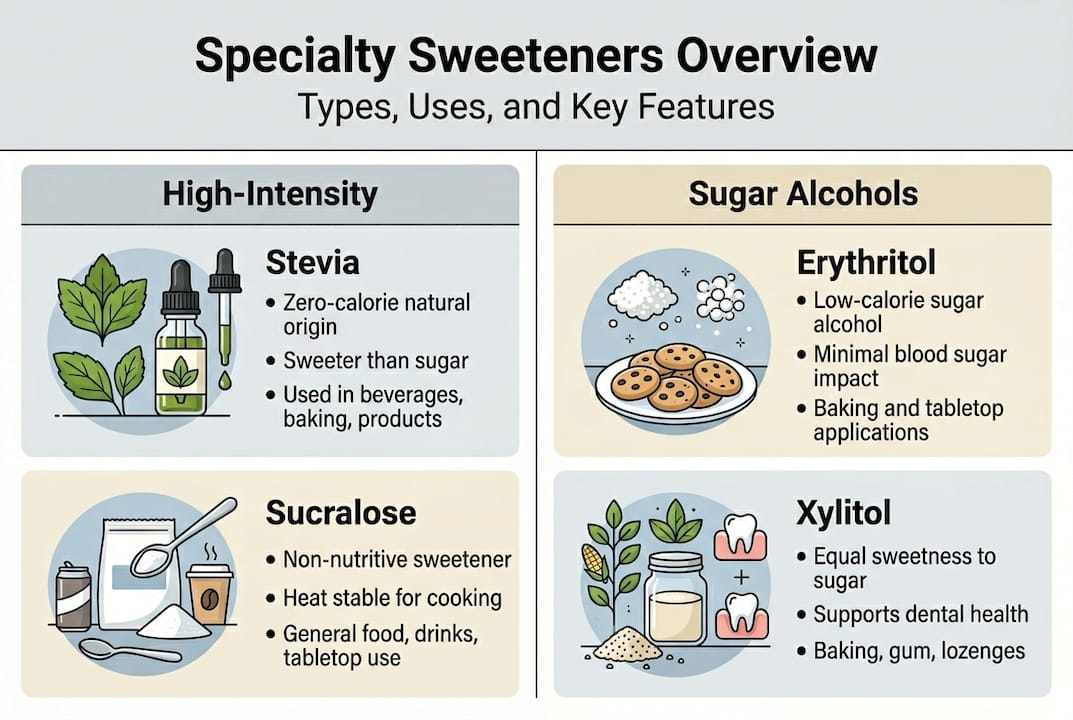
Specialty sweeteners are alternatives to sucrose, engineered or naturally derived, that serve one or more of three goals: reducing calories, managing glycemic response, and meeting clean-label or regulatory expectations. They are not interchangeable with table sugar. Each type behaves differently in solution, under heat, and on the palate.
The main categories include:
- High-intensity sweeteners (HIS): Stevia, monk fruit, sucralose, aspartame. These deliver sweetness at a fraction of the quantity needed versus sugar.
- Sugar alcohols: Erythritol, xylitol, sorbitol, maltitol. Lower in calories than sugar, widely used in confections and “sugar-free” labeling.
- Rare sugars: Allulose, tagatose, D-psicose. Structurally similar to sugar but metabolized differently, offering near-zero net calories.
Manufacturers turn to these types of bulk specialty sweeteners for a range of strategic reasons: pressure from health-focused consumers, emerging sugar taxes in global markets, and regulatory incentives for reduced-calorie labeling. The business case is real.
The numbers confirm the shift. The specialty sweeteners market was valued at USD 12.26 billion in 2024, growing at a CAGR of 4.34%. That growth is fueled by demand across sweeteners for beverage manufacturing, bakery, dairy, and beyond.
| Category | Examples | Calorie profile | Primary use case |
|---|---|---|---|
| High-intensity sweeteners | Stevia, monk fruit, sucralose | Near-zero | Beverages, tabletop, health foods |
| Sugar alcohols | Erythritol, xylitol | 0.2 to 2.4 kcal/g | Confections, gums, baked goods |
| Rare sugars | Allulose, tagatose | 0.2 to 0.4 kcal/g | Baked goods, beverages, keto products |
Major classes of specialty sweeteners: Features and use cases
Knowing the category names is only the starting point. The real differentiation shows up in how each sweetener performs in your production environment.
High-intensity sweeteners like stevia and sucralose are 200 to 400 times sweeter than sucrose. They require precise dosing and behave very differently depending on pH and heat. Sucralose holds up well in high-temperature baking; stevia can turn bitter above certain concentrations. For how sweeteners affect flavor, heat stability and onset time are the two biggest functional variables to model first.
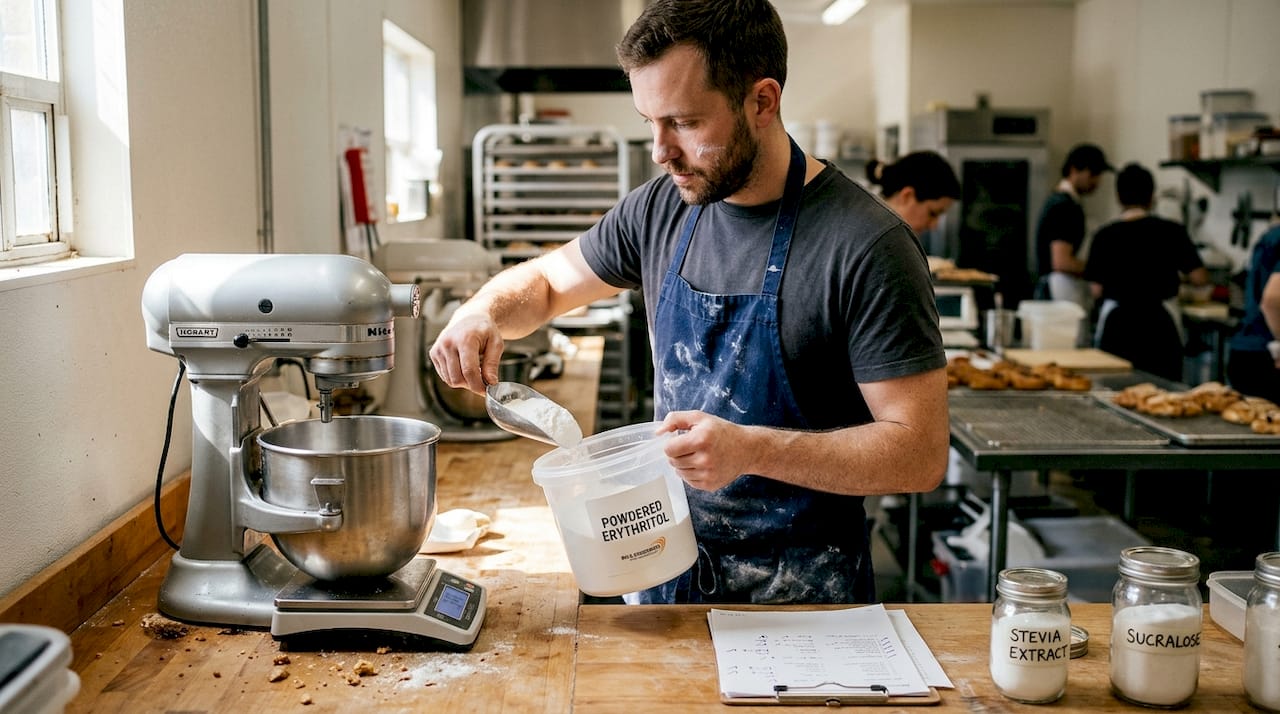
Sugar alcohols are popular in confections, functional gums, and reduced-sugar bakery because they contribute bulk and mouthfeel that HIS cannot. Erythritol has the cleanest taste profile of the group. Xylitol has dental health benefits but causes digestive issues at high intake levels, which matters for labeling.
Rare sugars like allulose are gaining traction fast. Allulose behaves like sugar in browning, moisture retention, and texture but contributes almost no calories. That makes it a strong performer in baked goods and ice cream where sugar functionality is hard to replicate.
Here is a quick comparison for formulation planning:
| Sweetener | Heat stable | Aftertaste risk | Bulk/mouthfeel | Keto/clean-label compatible |
|---|---|---|---|---|
| Stevia | Moderate | High (licorice) | No | Yes |
| Sucralose | High | Low to moderate | No | Artificial label |
| Erythritol | High | Low (cooling) | Partial | Yes |
| Allulose | High | Very low | Yes | Yes |
Natural sweeteners preferred for labeling like stevia and xylitol often require blending to mask aftertaste. Clean-label product developers who skip the blending step typically get consumer complaints that derail launch timelines.
Pro Tip: Combine a fast-onset HIS with a mid-onset sweetener like erythritol to build a taste profile closer to sucrose. This approach is common in successful clean-label sweeteners strategies for functional beverages.
Regulatory and labeling considerations
Regulation shapes every sourcing and formulation decision you make with specialty sweeteners. The frameworks are not uniform globally, and staying ahead of them is non-negotiable for any manufacturer selling across borders.
Here is a straightforward breakdown of what matters most:
- FDA (United States): Most approved HIS hold GRAS status. Acceptable daily intake (ADI) limits apply to aspartame and saccharin. Allulose received an exemption from total and added sugar counts on the Nutrition Facts label, which is a major labeling advantage.
- EFSA (European Union): Stricter on novel foods. Stevia extracts are approved; monk fruit (luo han guo) approvals are still limited in some EU member states. ADI limits for all HIS are enforced.
- CODEX Alimentarius: Sets international baseline standards adopted by many emerging market regulators. Useful reference for global supply chain planning.
- WHO guidance: 2023 WHO recommendations cautioned against using non-sugar sweeteners for weight management, which has ripple effects on health claim approvals in some jurisdictions.
“Regulations drive the use of specialty sweeteners at every stage: FDA and EFSA approvals define market access, sugar taxes accelerate reformulation, and ADI limits constrain dosing flexibility even for GRAS ingredients.”
For manufacturers, sweetener trends for manufacturers in 2026 are shaped heavily by sugar reduction mandates in the UK, emerging sugar taxes in Southeast Asia, and tightening natural claim standards in North America. Building regulatory flexibility into your sourcing strategy is not optional anymore.
Managing taste challenges: Formulation strategies
Compliance gets you to the shelf. Great taste keeps your product there. The biggest technical challenge with specialty sweeteners is the temporal taste profile, meaning how quickly the sweetness arrives, how long it lingers, and how cleanly it fades.
Sucrose has a clean, fast onset and a short decay. Most specialty sweeteners deviate from this in ways that consumers notice immediately. Temporal profiles differ between sweeteners, affecting perceived balance, and this is where many reformulated products lose consumer acceptance.
Key formulation strategies include:
- Blending for balance: Pair a fast-onset HIS (like sucralose) with a mid-curve sweetener (like erythritol) to simulate sucrose’s curve more closely.
- Flavor maskers: Ingredients like glycine, certain cyclodextrins, and natural flavor modifiers suppress the licorice or metallic notes in stevia and monk fruit.
- Bulk building: Use allulose or sugar alcohols to restore mouthfeel and body that disappears when sucrose is removed.
- pH control: Stevia performs better in slightly acidic formulations. Adjust pH to reduce bitterness before adding masking agents.
Pro Tip: Layer a fast-onset sweetener with a late-onset one, like combining monk fruit with erythritol, to smooth out the taste curve across the full flavor experience. This strategy is widely used in better-for-you sodas and has driven measurable aftertaste reduction, as seen in sugar-free soda development where date-based sweeteners are layered with HIS for cleaner finish.
For flavor manufacturing sweeteners, nailing the temporal profile is not a nice-to-have. It is what separates repeat buyers from one-time trial.
Market trends and buyer considerations for 2026
The market is moving fast, and the manufacturers gaining ground are the ones who connect technical capability to consumer momentum.
The specialty sweeteners market is projected to reach USD 19.56 billion by 2035 at a CAGR of 4.34%, driven by sugar reduction regulations and consumer health awareness. That is not a distant forecast. Procurement decisions made today lock in formulation flexibility for years.
Here is what buyers should prioritize right now:
- Supply security: Stevia and monk fruit sourcing concentrates heavily in China. Diversify your supplier base to reduce geopolitical exposure.
- Regulatory alignment: Source sweeteners with current GRAS documentation or EU novel food authorization already in place.
- Functionality fit: Match the sweetener’s functional properties to your application before price-shopping. A cheaper erythritol source that crystallizes unexpectedly in your beverage line costs more in the end.
- Consumer perception: Clean-label and keto claims drive purchase intent. “Natural” on the front of pack still commands a premium in most categories.
- Cross-category innovation: Guilt-free snacking trends are pushing specialty sweeteners into savory segments including sauces, snacks, and even pet food, broadening your potential application scope.
For 2026 sweetener market insights, the clearest trend is that health claims are becoming a baseline expectation, not a premium differentiator. Manufacturers who have not yet built sweetener flexibility into their R&D pipeline are already behind.
A fresh perspective: Navigating complexity and making specialty sweeteners work for you
Here is an uncomfortable reality most ingredient guides skip: the manufacturers who struggle most with specialty sweetener reformulation are not struggling because the ingredients are technically difficult. They are struggling because they treat sweetener selection as a substitution exercise rather than a formulation strategy.
Swapping stevia for sucrose at equivalent sweetness intensity without adjusting bulk, pH, or temporal profile is not reformulation. It is guessing. And consumer research punishes guessing quickly.
The manufacturers building strong portfolios are doing three things differently. First, they test blends before committing to bulk orders, using small-batch trials to map temporal profiles against target benchmarks. Second, they track global regulations proactively, not reactively, so that when a new sugar tax or novel food approval drops, their formulas are already positioned to benefit. Third, they think about achieving clean-label status as a brand equity investment, not just a compliance checkbox.
Specialty sweeteners done right are not a compromise. They are a formulation advantage that compounds over time as consumer preferences continue shifting away from traditional sugar.
Sourcing bulk specialty sweeteners: Your next step
Putting this knowledge into practice starts with having the right supply partner behind you. US Sweeteners works with food and beverage manufacturers across bakery, beverage, dairy, and confections to deliver bulk specialty sweeteners for manufacturing at the scale and spec your production requires.
Whether you are sourcing erythritol for a reduced-calorie beverage line or allulose for a clean-label bakery product, our team can support your formulation, regulatory, and supply chain needs from a single point of contact. Explore our full range of bulk sweeteners for flavor enhancement or browse the complete sweetener options portfolio to find the right match for your next product launch.
Frequently asked questions
What are the main types of specialty sweeteners available in bulk?
Bulk specialty sweeteners fall into three primary groups: high-intensity sweeteners such as stevia and monk fruit, sugar alcohols like erythritol and xylitol, and rare sugars including allulose and tagatose. Each group has distinct caloric, functional, and labeling profiles.
Do specialty sweeteners require specific labeling in the US?
Yes. Most specialty sweeteners require ingredient declaration on the label, and some carry “natural” or “artificial” origin designations that affect marketing claims. FDA and EFSA approvals define which sweeteners can be used and at what levels, and GRAS status does not eliminate all labeling obligations.
How do manufacturers mask off-flavors or aftertastes in specialty sweetener formulas?
The most effective approach is blending sweeteners with complementary temporal profiles, paired with flavor maskers like glycine or natural flavor modifiers. This smooths out the taste curve and reduces the bitterness or licorice notes that single-sweetener systems often produce.
Why are specialty sweeteners growing in market share?
Market growth at 4.34% CAGR is driven by a combination of consumer health awareness, sugar reduction regulations, and the premium pricing power that clean-label and low-calorie claims command across most food and beverage categories.
Are there any long-term health or formulation risks with specialty sweeteners?
Approved sweeteners are considered safe for use within ADI guidelines, but long-term metabolic effects of high-intensity sweeteners, particularly their impact on gut microbiome and insulin response, remain an active area of research and regulatory monitoring.