

Assuming any non-dairy sweetener will simply slot into your formulation without rework is one of the most expensive misconceptions in product development. The reality is that non-dairy sweetening spans a wide spectrum of technical profiles, sensory behaviors, regulatory thresholds, and sourcing complexities. For product managers and procurement teams, getting this wrong means reformulation costs, consumer complaints, or failed compliance audits. This article breaks down exactly what non-dairy sweetening means, which sweetener classes perform best under real manufacturing conditions, how to benchmark and validate your choices, and what decision frameworks keep your supply chain clean and your SKUs on shelf.
Table of Contents
- What is non-dairy sweetening? Definition and context
- Main types of non-dairy sweeteners and their properties
- Performance benchmarks and sensory impact
- Application pitfalls, regulatory limits, and emerging sweetener science
- Selecting the right non-dairy sweetening system for your application
- What most R&D teams miss when choosing non-dairy sweeteners
- Bulk non-dairy sweetener solutions for manufacturers
- Frequently asked questions
Key Takeaways
| Point | Details |
|---|---|
| Definition matters | Knowing the regulatory and formulation distinctions in non-dairy sweetening ensures successful product development. |
| Benchmark with data | Use empirical benchmarks to evaluate performance, taste, and acceptance in your applications. |
| Test and blend smartly | Avoid pitfalls by testing sweetener blends for sensory and technical fit early in development. |
| Monitor regulations | Stay updated on ADI limits and the latest ingredient science to future-proof your products. |
What is non-dairy sweetening? Definition and context
Non-dairy sweetening refers to the use of sweetening ingredients that contain no milk-derived components in a formulation. In practice, this covers products ranging from plant-based creamers and oat milk beverages to vegan frozen desserts and dairy-free confections. The term sounds straightforward, but the edge cases matter enormously.
Here is where many teams stumble. “Non-dairy” on a label does not automatically mean vegan or allergen-safe. Sodium caseinate, a milk-derived protein, appears in many commercial non-dairy creamers and technically disqualifies them for consumers with dairy allergies or vegan dietary requirements, per the dairy-free snacking guide. Your sweetening system must be vetted independently from the base ingredient claim.
Common applications for non-dairy sweetening include:
- Plant-based creamers and whiteners (coffee, tea, culinary)
- Frozen dairy alternatives (oat, coconut, almond-based)
- Beverages (RTD plant milks, functional drinks)
- Bakery and confectionery (vegan coatings, fillings, cookies)
- Sauces and dressings where dairy-free is a labeling requirement
The FDA notes that corn syrup solids provide mild sweetness and solubility in these systems, with alternatives including glucose syrup, high fructose corn syrup, or in reduced-sugar versions, stevia and monk fruit. Each brings different functional properties.
The industry drivers accelerating non-dairy sweetening adoption are real and measurable. Allergen-free labeling requirements, the sustained growth of plant-based product lines, and rising consumer demand for clean-label formulations are pushing every major food manufacturer to build non-dairy sweetening competency. Plant-based sweeteners are no longer a niche consideration. They are a core formulation strategy.
Key insight: Non-dairy does not equal vegan. Always audit your full ingredient stack, including processing aids and carrier systems, before making any label claim.
Main types of non-dairy sweeteners and their properties
Not all non-dairy sweeteners behave the same in your process. The table below gives a working overview of the major classes, their technical roles, and relevant regulatory considerations.
| Sweetener | Type | Relative sweetness vs. sucrose | Key function | Notes |
|---|---|---|---|---|
| Corn syrup solids | Bulk | 0.3x to 0.5x | Solubility, body, shelf stability | Most common base |
| Glucose syrup | Bulk | 0.5x to 0.7x | Viscosity, freeze-point control | Clean flavor |
| High fructose corn syrup | Bulk | 1.0x to 1.2x | Cost-effective sweetness | Label perception issue |
| Sucralose | High-intensity | 600x | Sweetness with no calories | Possible bitter linger |
| Stevia (steviol glycosides) | High-intensity | 200x to 350x | Natural-label, low calorie | ADI 4 mg/kg body weight/day |
| Monk fruit | High-intensity | 150x to 200x | Clean sweet profile | Premium cost |
| Allulose | Bulk/rare sugar | 0.7x | Mouthfeel, browning, freeze-point | 0.4 kcal/g |
| Sugar alcohols (erythritol, sorbitol) | Bulk | 0.6x to 0.8x | Reduced calorie, texture | GI effects above 6% intake |
Blending bulk sweeteners with high-intensity options is where real formulation leverage exists. Using stevia or monk fruit in combination with corn syrup solids lets you reduce added sugar while maintaining body and mouthfeel. For organic sweetener options, certified organic stevia and monk fruit are available at scale.
Common pitfalls to watch:
- Off-notes from sucralose and high-dose stevia (metallic or bitter linger)
- GI distress from sugar alcohols exceeding 6% of formulation
- Poor browning in baked applications without allulose in the blend
- Allergen cross-contamination if shared processing lines handle dairy-adjacent sweetener blends
For applications where sweetness drives flavor perception, pairing a high-intensity sweetener with a functional bulk sweetener pays dividends in sweeteners for flavor enhancement performance.
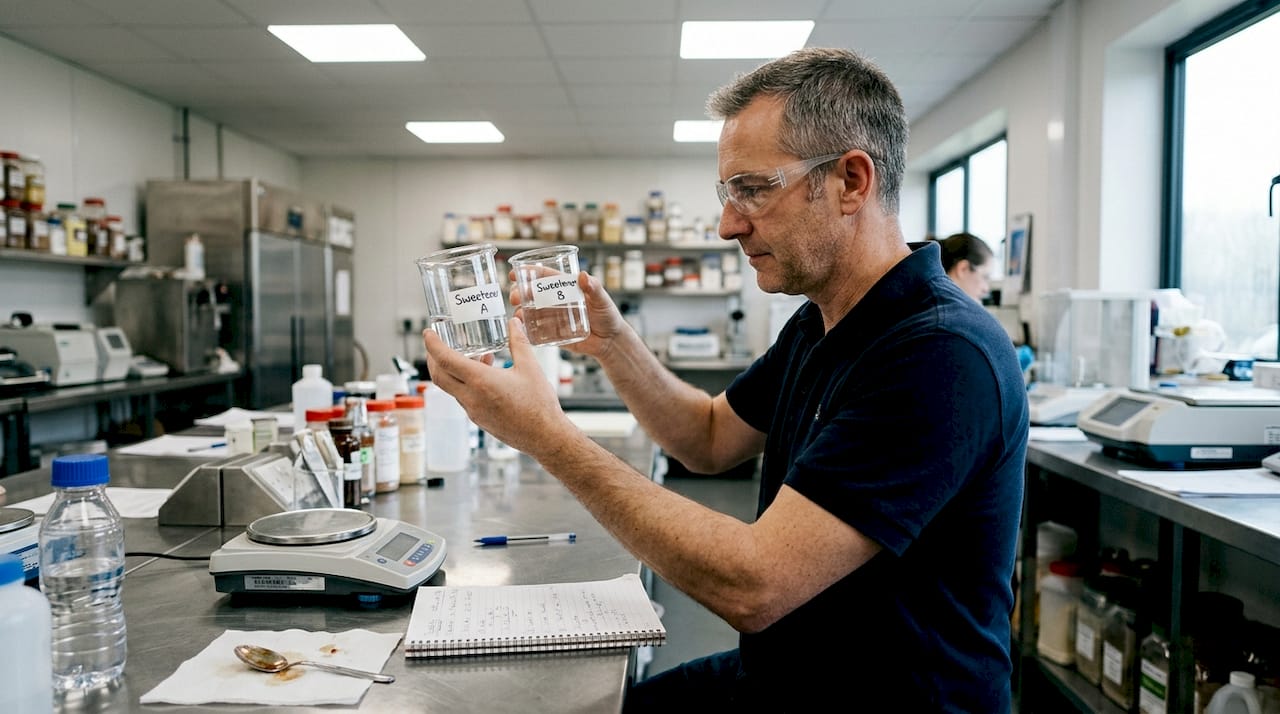
Pro Tip: Always screen sweetener blends at bench scale against your target Brix level and pH before locking in a formulation. Sensory interactions shift dramatically with process temperature and product acidity. Choosing vegan-compatible sweeteners early in development prevents costly late-stage reformulation.
Performance benchmarks and sensory impact
Benchmarks give your team a target and a baseline for failure analysis. Without them, you are guessing.
For frozen dairy alternatives, empirical data from optimized vegan ice cream formulations is instructive. Research shows an optimized formulation using 11.32% date syrup plus 5.81% fructooligosaccharides (FOS) achieved overrun of 65.14%, melt rate of 40.85%, fat at 18.5%, and total carbohydrates at 10.60%, outperforming higher-carb control batches. These are meaningful numbers for product managers setting quality gates.
| Performance metric | Traditional dairy | Non-dairy target | Non-dairy best case |
|---|---|---|---|
| Overrun | 70% to 90% | >60% | 65% to 75% |
| Melt rate | 35% to 45% | <45% | 40% to 42% |
| Sweetness intensity | Baseline | Match or slightly below | On par with blending |
| Consumer acceptance score | 8.0 to 9.0/10 | >7.0/10 | 7.5 to 8.5/10 |
Stat callout: Vegan ice cream with natural sweetener blends achieved overrun exceeding 65%, a key mouthfeel indicator that rivals traditional dairy formulas when sweetener ratios are properly optimized.
Sensory scoring in consumer panels consistently flags two issues in non-dairy sweetened products: temporal mismatch (sweetness arrives too fast or lingers too long) and flavor thinness (insufficient body from replacing sucrose). Bulk sweeteners like corn syrup solids and glucose syrup directly address flavor thinness. Temporal mismatch requires blend design rather than simple substitution.
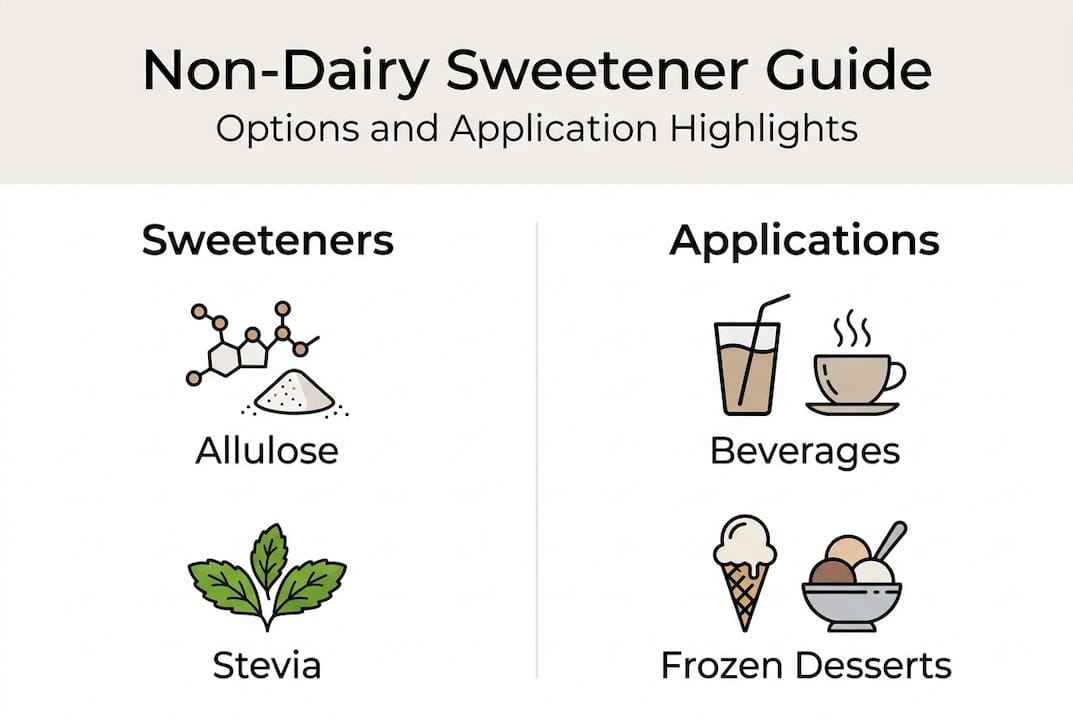
For your frozen product sweeteners selection, prioritize sweeteners with demonstrated freeze-point depression activity, since this directly impacts texture and scoopability. Allulose and glucose syrup both perform well here. Date syrup adds antioxidant and phenolic content that supports nutrition marketing claims, though it adds color and flavor complexity that must be managed.
Review vegan snack benchmarks for cross-category data if your application sits outside frozen desserts.
Application pitfalls, regulatory limits, and emerging sweetener science
Knowing the benchmarks is half the battle. Avoiding the traps that derail real-world launches is the other half.
The most common technical and regulatory pitfalls include:
- Sodium caseinate contamination in “non-dairy” base ingredients, which disqualifies products for both vegan and dairy-allergic consumers
- Bitter linger from stevia at high use levels. Blending stevia with allulose reduces this significantly
- Trans fat contamination in older non-dairy creamer formulations. Non-hydrogenated oils are now the standard, but supplier verification is still required
- GI side effects from sugar alcohols exceeding approximately 6% of formulation weight
- Poor Maillard browning in baked goods when sucrose is replaced without allulose in the blend
- Regulatory drift as international thresholds for high-intensity sweeteners continue to evolve
On the innovation side, bioproduction methods using enzymatic and microbial processes are now scaling rare sugars like allulose and high-purity steviol glycosides at commercially viable costs. Response surface methodology (RSM) is the current best-practice optimization tool for sweetener blends in complex matrices like coconut milk or oat cream bases. Pearson correlation analysis linking solid fat content and fatty acid profiles to sensory outcomes is also giving formulators tighter predictive tools for taste modeling.
Key regulatory note: Trans fats are phased out. Verify that every non-dairy sweetener carrier or encapsulant in your supply chain uses non-hydrogenated oils. One non-compliant ingredient can affect your entire product line.
Pro Tip: Run RSM-guided blend trials early and include process simulation (heat, shear, freeze-thaw cycles) to catch sweeteners for texture failures before pilot scale. A single off-note discovered late costs far more than a robust early-stage screening program.
Selecting the right non-dairy sweetening system for your application
With technical knowledge in hand, the challenge shifts to systematic decision-making under real procurement and regulatory constraints.
Critical selection criteria for product managers:
- Technical fit: Solubility, viscosity, freeze-point depression, browning behavior, and Brix contribution
- Sensory profile: Temporal sweetness match, absence of off-notes, mouthfeel contribution
- Regulatory compliance: ADI limits, GRAS status, country-specific approvals for target markets
- Allergen status: Full traceability and documentation from ingredient source to finished product
- Supply chain reliability: Minimum order quantities, lead times, and availability of COAs
- Cost modeling: Sweetener cost per unit of perceived sweetness, not just per kilogram
Benchmarks for procurement indicate that customizable non-dairy creamer specs target fat at 20% to 35%, with sweetness delivered via corn syrup solids or stevia blends. Frozen dairy alternative targets are overrun above 60% and melt below 45%. Blends consistently reduce both cost and off-note risk compared to single-sweetener systems.
| Decision driver | Key question | Primary sweetener options |
|---|---|---|
| Lowest cost per sweetness unit | What hits target Brix cheapest? | Corn syrup solids, HFCS |
| Clean label requirement | Can we avoid refined sugars? | Stevia, monk fruit, date syrup |
| Mouthfeel priority | What replaces sucrose bulk? | Allulose, glucose syrup, erythritol |
| Allergen-free guarantee | Is every carrier verified? | Verified single-origin sweeteners |
| Browning in baked formats | Does the formula caramelize properly? | Allulose, glucose syrup |
For teams sourcing at scale, partnering with a sweetener supplier for manufacturing that can provide technical documentation and formulation guidance reduces validation time significantly. Review strategic non-dairy sweetener choices for additional sourcing frameworks.
What most R&D teams miss when choosing non-dairy sweeteners
Here is the uncomfortable reality: most teams default to sweeteners that worked in their dairy-based products and apply them directly to non-dairy formulations. That approach fails more often than it should, and the reason is almost always temporal profile mismatch.
Dairy systems buffer sweetness through fat and protein interactions. Remove those and a sucralose or high-stevia system that performed well in yogurt will deliver a completely different sensory curve in an oat cream. The sweetness arrives earlier, lingers longer, and feels thin. No amount of dosage adjustment fixes a fundamental temporal mismatch. You need a different sweetener architecture.
Research confirms that allulose is currently the best bulk sweetness mimic at 70% of sucrose sweetness and only 0.4 kcal/g, with a GRAS approval and a practical daily limit of 30 grams. Fermentation-enhanced steviol glycosides deliver higher purity and reduced bitterness compared to standard stevia extracts, which matters at functional use levels.
The teams that get this right run cross-functional sensory and technical screening in parallel, not sequentially. They prototype early, stress-test across processing conditions, and treat sweetener selection as a system design problem rather than a single-ingredient swap. The payoff is faster time-to-market and far fewer reformulation cycles. Explore solving flavor challenges for a framework that integrates sweetener selection with flavor optimization from the start.
Bulk non-dairy sweetener solutions for manufacturers
If you are moving from evaluation to procurement, the supply chain decisions you make now determine your formulation flexibility for years.
US Sweeteners supplies bulk sweeteners and enhancers including corn syrup solids, glucose syrup, allulose, stevia, and specialty blends specifically configured for large-scale non-dairy manufacturing. Our sourcing network spans international mills and domestic US suppliers, giving your procurement team verified, trans-free, allergen-documented ingredients at the volumes you need. From liquid sugar supplies for beverage and creamer applications to dry bulk formats for bakery and confectionery, we offer custom specifications, private label, and rapid logistics from multiple warehouse locations. Contact our team to discuss your formulation targets and request a bulk sugar supply quote tailored to your production scale.
Frequently asked questions
What is the difference between non-dairy and vegan sweetening?
Non-dairy sweetening excludes milk-derived ingredients, but may still contain animal-derived additives such as sodium caseinate, which disqualifies products for vegans or consumers with dairy allergies. Vegan sweetening is strictly plant-based, with no animal products anywhere in the ingredient or processing chain.
Which non-dairy sweeteners offer the closest taste to sucrose?
Allulose and blends combining stevia with allulose consistently deliver bulk and sweetness profiles closest to sucrose across most applications. Allulose provides approximately 70% of sucrose sweetness at only 0.4 kcal/g, making it the leading functional substitute.
What are the typical regulatory limits for high-intensity sweeteners?
Limits vary by compound and market. Steviol glycosides carry an ADI of 4 mg/kg body weight per day in the US, while allulose GRAS guidelines set a practical daily intake ceiling of 30 grams.
What bulk sweetener is best for maintaining mouthfeel in frozen dairy alternatives?
Corn syrup solids and date syrup combined with FOS are validated options for frozen dairy alternatives. Optimized blends using 11.32% date syrup plus 5.81% FOS achieved overrun of 65.14% and melt rate of 40.85%, closely matching traditional dairy performance targets.