Agave Syrup Substitute: The Complete Replacement Guide
Quick answers before we dive in
For home cooks: The best agave syrup substitute is honey or maple syrup, and liquid sweeteners can often replace agave at a 1:1 ratio. Both match agave’s texture and sweetness closely enough that most recipes work without other changes. If you need a vegan swap, use maple syrup or simple syrup.
For commercial formulators: Liquid sucrose, HFCS 55, a 70-30 sugar-HFCS blend, or tapioca syrup all substitute for agave at 1:1. Which one you choose depends on supply stability, fructose consistency, label strategy, browning behavior, and cost target — the same factors that make agave expensive and harder to formulate with at scale.
This guide covers both audiences. Home cooks can stop at the comparison table further down; commercial buyers should read through the full B2B section for substitution ratios, baking behavior, flavor and texture tradeoffs, formulation challenges, and health and labeling considerations.
Best Agave Syrup Replacement for Home Cooks
The five best agave syrup replacements home cooks reach for:
- Honey — 1:1 ratio, closest match in texture and pourability
- Maple syrup — 1:1 ratio, adds a light maple note, great in baking
- Simple syrup — 1:1 ratio, neutral flavor, best for cocktails and iced drinks
- Coconut nectar — 1:1 ratio, vegan, low glycemic index
- Date syrup — 1:1 ratio, rich fruity flavor, ideal for spice cakes and oatmeal
Full comparison table with notes on each swap is right below.
Best Agave Syrup Alternative for Baking
For baking specifically, the ranking changes because browning behavior and moisture retention matter more than pourability in cooking:
- Maple syrup (1:1) — closest match for baked goods; its distinct caramel flavor works well in cookies, muffins, and quick breads, and it’s slightly less sweet than agave
- Honey (1:1) — excellent moisture but browns faster; drop oven temperature 25°F
- Brown sugar syrup (1:1) — dissolve brown sugar in hot water for a homemade agave-style syrup with richer flavor
- Date syrup (1:1) — best in spice cakes, banana bread, and energy bars
- Brown rice syrup (2:1) — use twice as much; it has a mild taste, is less sweet than agave, and works well as a binder in granola bars
When replacing agave for dry sugar in a recipe, use 2/3 cup agave per 1 cup of sugar and reduce other liquids by ~1/4 cup — agave is about 40% sweeter than granulated sugar and adds moisture, while dry sweetener substitutes usually require liquid adjustments.
Can Agave Be Substituted for Honey?
Yes — agave can be substituted for honey at a 1:1 ratio in almost any recipe, though honey brings a more noticeable flavor than agave in cooking and baking. Agave is slightly thinner and about twice as sweet per volume as honey, so it works especially well in cold drinks, dressings, and no-bake recipes. In baking, agave browns faster than honey, so reduce oven temperature by 25°F or shorten bake time by a few minutes.
Agave is also the go-to honey substitute for vegan recipes, since honey is an animal product and agave is plant-derived.
Can You Substitute Honey for Agave?
Yes — honey substitutes for agave at a 1:1 ratio, though in cooking and baking it brings a more pronounced flavor than agave, much like sweeteners such as maple syrup do. Honey is slightly thicker and has a stronger flavor, so reduce other liquids in the recipe by 1–2 tablespoons per cup of agave you’re replacing.
Honey is not vegan — if you need a plant-based agave alternative, use maple syrup or simple syrup instead. For hot drinks and dressings, honey works without any recipe adjustment. For cocktails, dissolve the honey in a splash of warm water first so it mixes cleanly.
Why agave became popular in the first place
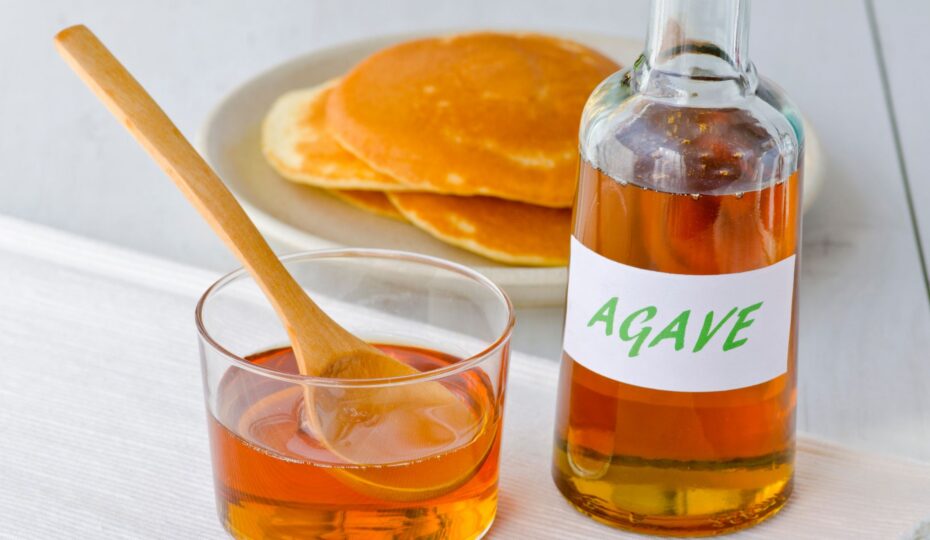
Agave nectar is the heated, filtered sap of the blue agave plant grown mostly in arid regions of Mexico. The heating step hydrolyzes complex carbohydrates (inulin and fructans) into simple sugars — primarily fructose. The result is a thin, mildly sweet syrup that pours easily and dissolves cleanly in cold drinks. Agave nectar is valued for its sweet flavor and as a natural, popular sweetener.
For home cooks reading along: Think of agave the way you’d think of honey — same job (sweeten things), similar pourability, slightly different flavor. Agave syrup is a liquid sweetener commonly used in baking recipes and beverages, thanks to its ability to dissolve easily in both hot and cold drinks like tea, coffee, smoothies, and cocktails. The reason it got popular wasn’t taste; it was the marketing around its low glycemic index (GI).
At-a-glance: agave syrup specs
| Property | Typical value | Source |
|---|---|---|
| Fructose content | 70–90% | USDA FoodData Central |
| Glycemic index | 15–30 (varies by sample) | University of Sydney GI Database |
| Calories per tbsp | ~60 kcal | USDA FoodData Central |
| Plant maturation | 7–10 years before harvest | USDA ARS |
| Origin | Blue agave, Mexico | Tequila Regulatory Council |
Agave nectar contains more calcium, iron, and magnesium than many other sweeteners, along with significant amounts of vitamin C and B vitamins.
Translation: industry jargon, in plain English
Before we go further, a quick decoder for the technical terms used in the rest of this article:
- Brix: A measurement of dissolved sugar solids in a liquid. Higher Brix = more sugar by weight, and syrup types differ in thickness and consistency. A simple syrup at home is roughly 50° Brix.
- Maillard browning: The chemical reaction between sugars and proteins that makes baked goods golden brown. Different sugars brown at different rates and temperatures.
- Humectancy: A sweetener’s ability to hold onto moisture. Important in shelf-stable baked goods and frozen desserts.
- GI (glycemic index): How quickly a food raises blood sugar on a 0–100 scale, reflecting how quickly it affects blood sugar levels. Below 55 is considered low (Harvard Health).
- HFCS: High Fructose Corn Syrup. The number after it (42, 55, 90) refers to the fructose percentage; glucose content also affects sweetness and blood sugar response.
- DE (Dextrose Equivalent): A measure of how much corn syrup has been broken down from starch into sugars. Higher DE = sweeter, more fermentable.
Why food manufacturers look for agave substitutes
In over a decade supplying sweetener systems to North American food and beverage manufacturers, we’ve seen the same five reasons come up again and again. Many manufacturers are seeking a healthier alternative or healthier choice to manage sugar intake and avoid artificial sweeteners. These are production-floor issues, not ideology.
1. Inconsistent fructose content = formulation risk
Agave syrup runs 70–90% fructose depending on plant variety, maturity, and processing method. That range is too wide for predictable sweetness intensity, browning behavior, and water activity in finished product. By contrast:
- HFCS 55 holds fructose at a tightly controlled 55% (Corn Refiners Association)
- Liquid sucrose delivers a fixed 99%+ sucrose profile batch to batch
- Tapioca syrup can be produced to specific DE targets
2. Long supply lead times
Blue agave plants take 7–10 years to mature before harvest. That schedule doesn’t sync with industrial production demand cycles. When agave prices spiked between 2018 and 2022, commercial buyers who had standardized on it had nowhere to pivot quickly (Reuters).
3. Flavor drift across processing grades
Light agave is nearly flavor-neutral, while dark agave has the strongest flavor profile, often compared to molasses or caramel. Different grades of agave syrup have distinct flavor profiles, which can impact recipe outcomes. Suppliers don’t always grade consistently, which creates quality control headaches for white cakes, clear beverages, and light confections.
4. Unpredictable browning
Agave’s high fructose load accelerates Maillard browning — but unevenly. Sucrose-based sweeteners give bakers tighter color and crust control.
5. Cost premium without functional payoff
Agave costs significantly more per pound-of-sweetness than sucrose-based or corn-based alternatives, and that premium rarely buys anything functional at industrial scale.
Best Agave Syrup Substitutes for Manufacturers
Liquid sucrose — the clean-label benchmark
Liquid sucrose, made from cane sugar or beet sugar, is dissolved table sugar at a fixed Brix, usually 66–67°. It’s a common syrup substitute for agave, serving as the workhorse for bakeries, beverage producers, and confectioners who need clean flavor, consistent crystallization behavior, and the familiar “sugar” tag on the ingredient label.
- Substitution ratio: 1:1 for agave
- Best for: Cakes, cookies, glazes, soft drinks, syrups, neutral-flavor applications
- Grades available: Kosher, Non-GMO, Organic
- Documentation: CoA, allergen statement, country-of-origin, GFSI certification
HFCS 55 — humectancy and freeze-point control
HFCS 55 is a liquid sweetener, enzymatically processed corn syrup standardized to 55% fructose. It’s roughly 1.0–1.1× as sweet as sucrose (FDA — HFCS Q&A) and brings excellent solubility, humectancy, and freeze-point depression. It’s a beverage and frozen-dessert staple.
- Substitution ratio: 1:1 for agave
- Best for: Soft drinks, sports beverages, moist baked goods, cereals, condiments, frozen products
70-30 Sugar-HFCS Blend — the cost-and-flavor compromise
A pre-blended 70% liquid sucrose / 30% HFCS 55 system. Gives you the clean sweetness of sucrose with the humectancy and cost cushion of HFCS, plus hedge value against single-feedstock price exposure.
- Substitution ratio: 1:1 for agave
- Best for: High-volume bakery and beverage applications where both cost and flavor matter
Tapioca syrup — the clean-label, non-GMO answer
For brands that need an alternative to agave without leaning on corn-based syrups, tapioca syrup is the most direct functional match. While it performs similarly, consistency varies among sweeteners, and some options pour more like a thick syrup than agave. It has a syrup consistency similar to agave and is considered a natural sweetener. It’s neutral-flavored, available in Non-GMO and Organic grades, and produced at scale in supply chains that don’t have agave’s 7–10-year lead time.
- Substitution ratio: 1:1 for agave
- Best for: Organic/natural label bakery, nutrition bars, beverages, confections
Agave substitute comparison (B2B)
| Substitute | Best for | Key benefit | Ratio | Typical grades |
|---|---|---|---|---|
| Liquid sucrose | Bakery, beverage, glazes | Clean flavor, predictable browning | 1:1 | Kosher, Non-GMO, Organic |
| HFCS 55 | Soft drinks, frozen, moist bakery | Humectancy, freeze-point depression | 1:1 | Kosher |
| 70-30 Sugar-HFCS Blend | High-volume bakery/beverage | Cost efficiency, supply hedge | 1:1 | Kosher |
| Tapioca syrup | Clean-label, organic, non-GMO lines | Non-GMO supply, neutral flavor, thick syrup viscosity | 1:1 | Kosher, Non-GMO, Organic |
For home cooks: realistic agave swaps
If you’re reading this from a home kitchen, the four B2B options above aren’t the right tools. Here’s what is. If you need an agave nectar substitute fast, many of these are probably already in your pantry, so you may not need a grocery store run.
| Home swap | Ratio | Best for | What to watch |
|---|---|---|---|
| Honey | 1:1 (excellent substitute) | Tea, hot drinks, dressings, marinades, baking recipes, salad dressings | Slightly thicker consistency; stronger flavor profile; caramelizes faster; reduce other liquids slightly |
| Maple syrup | 1:1 (great alternative) | Pancakes, baking recipes, glazes, hot drinks | Similar consistency but less sweet than agave; adds maple flavor; browns faster |
| Simple syrup (white sugar + hot water) | 1:1 (good substitute) | Cocktails, juice, iced beverages, baking recipes | Higher GI (~65); use less if you want milder sweetness; dissolves easily |
| Coconut nectar | 1:1 (good substitute) | Vegan baking, clean-label home recipes, hot drinks | Lower on the glycemic index than agave syrup; similar consistency; subtle caramel flavor; stronger than agave—may alter delicate recipes |
| Date syrup | 1:1 (good substitute) | Smoothies, oatmeal, muffins, spice cakes, energy bars | GI 47–54; very sweet with a rich caramel-fruit flavor; made from dates and water; nutritious; stronger than agave |
| Brown rice syrup | 2:1 (use twice as much) | Granola bars, energy bars, binding, baking recipes | Mild flavor; thicker consistency; less sweet; may require adding other liquids |
| Molasses/Blackstrap molasses | 1:1 (great alternative) | Baking, sauces, marinades, energy bars | Rich, robust flavor; high mineral content; thicker consistency; can overpower mild recipes |
| Brown sugar syrup | 1:1 | Baked goods, sauces, toppings, salad dressings | Rich flavor; easy to make by dissolving brown sugar in hot water |
| Fruit syrup | 1:1 (good substitute) | Cocktails, dressings, oatmeal, baking recipes | Customizable, natural sweetener; similar consistency; flavor varies by fruit |
Notes for home use
Honey is the closest 1:1 match — thicker and more flavorful, so reduce other liquids slightly. Maple syrup has a similar consistency but adds a maple note and is slightly less sweet. Coconut nectar is a low-glycemic option that’s stronger than agave, so you may not need the same amount in delicate recipes. Nutrition guidance also recommends using added sweeteners like agave in moderation.
Date syrup is made from dates and water — very sweet with a rich, fruity flavor, excellent in muffins or spice cakes. Brown rice syrup has a mild flavor and thicker consistency, but a higher glycemic index, so it works best when texture matters more than blood sugar impact. Molasses and blackstrap molasses give a robust flavor and nutritional benefits for baking and sauces.
When using agave as a replacement for dry sugar in baking recipes, use only 2/3 cup agave for every 1 cup of sugar and reduce other liquids by about 1/4 cup, since agave is roughly 40% sweeter than granulated sugar and contains more liquid. When substituting honey for agave syrup, use a 1:1 ratio, but reduce other liquids slightly due to honey’s thicker consistency. Fruit-based pastes like date paste work best for raw desserts, while syrup options are better for baked goods.
Other natural sweeteners include coconut sugar (a lower glycemic alternative) and stevia, which is derived from the stevia rebaudiana plant and offers high sweetness with low calories.
Switching sweeteners at scale: a five-point checklist
For B2B formulators, a sweetener change is never just “use a different jar.” A few things to verify before you run a production batch:
- Match viscosity and similar texture, not just sweetness. Verify pump rates, mixing times, and coating equipment are calibrated for the new syrup’s flow profile.
- Revalidate Brix targets. Different syrups carry different solids levels. Recheck dosing to maintain product density and sweetness.
- Account for browning differences. Sucrose-dominant syrups brown differently than fructose-dominant ones. Adjust oven temp or time as needed.
- Run a shelf-life validation. Water activity shifts can quietly change microbial stability or texture at 60–90 days.
- Document everything for QA. Update specs, allergen statements, and label claims before launch.
Documentation checklist for sweetener buyers
When you change a sweetener in a commercial product, your QA and procurement teams will typically need:
| Document | What it covers |
|---|---|
| Certificate of Analysis (CoA) | Brix, color, microbial counts, batch ID |
| Allergen statement | Major allergens including cross-contact risk |
| Country-of-origin declaration | Required for label compliance |
| GFSI / SQF / BRC certification | Food safety audit standing |
| Kosher / Halal certificates | If applicable to your channel |
| Organic certification | If marketed as organic |
| Non-GMO Project verification | If marketed as non-GMO |
| Safety Data Sheet (SDS) | Required for receiving and handling |
The fructose conversation — without the spin
This is the section where most agave articles get sloppy. Let’s keep it accurate.
What’s well-established:
- Excess added sugar of any kind — including agave, HFCS, honey, table sugar, and other sweeteners — is associated with adverse cardiometabolic outcomes (American Heart Association, Dietary Guidelines for Americans 2020–2025).
- A low glycemic index does not automatically mean a sweetener is healthier; total sugar load and frequency still matter, and while sweeteners can have nutritive differences, they are all still considered added sugars and should be used in moderation to help avoid diet-related health issues (Harvard T.H. Chan School of Public Health).
What’s contested or oversimplified:
- Claims that fructose from any source uniquely damages the liver or causes insulin resistance at typical dietary intakes are not as settled as they’re often presented. The evidence is strongest at very high intakes and in the context of overall caloric excess (National Institutes of Health review).
- Agave is not meaningfully “healthier” than table sugar. Both the AHA and the USDA Dietary Guidelines treat all added sugars equivalently.
Bottom line for formulators: If your product is positioned as “lower glycemic” or “diabetic-friendly,” your label and marketing claims need to be defensible under FDA’s added-sugar disclosure rules (FDA Nutrition Facts label changes). “Low GI” is not an FDA-defined claim.
Industry applications: which substitute fits where
- Carbonated beverages: HFCS 55 or 70-30 Blend (solubility, Brix consistency)
- Sports/functional drinks: Liquid sucrose or HFCS 55, depending on label strategy
- Soft baked goods (muffins, brownies): 70-30 Blend (humectancy + clean flavor)
- Hard baked goods (cookies, crackers): Liquid sucrose
- Clean-label / organic bakery: Tapioca syrup or organic liquid sucrose
- Nutrition bars: Tapioca syrup or brown rice syrup (binding behavior)
- Frozen desserts: HFCS 55 (freeze-point depression)
- Confectionery (gummies, caramels): Liquid sucrose plus invert sugar
- Sauces and dressings: Liquid sucrose or 70-30 Blend
How US Sweeteners supports agave-substitute buyers
We’re a U.S.-based bulk sugar distributor and bulk olive oil supplier serving distributors, wholesalers, bakeries, breweries, wineries, and food manufacturers nationwide.
- Pack formats: Drums, totes, tankers, and rail
- Certifications: Kosher, Non-GMO Project Verified, USDA Organic, SQF/BRC
- Documentation: Full CoA, allergen, country-of-origin, GFSI, kosher, organic, and SDS packages
- R&D support: Our team works directly with R&D and procurement on spec matching — not just order fulfillment
- Sample program: Request specs and samples before you commit to a reformulation
Request a sample + spec sheet · Talk to a sourcing specialist
Frequently asked questions
Can agave be substituted for honey?
Yes. Use a 1:1 ratio in cold drinks and dressings without changes. In baking, agave browns faster, so lower the oven temperature by 25°F. Agave is also the vegan-friendly swap for honey.
Can you substitute honey for agave?
Yes, 1:1. Honey is thicker, so reduce other liquids by 1–2 tablespoons per cup. Honey is not vegan — use maple syrup or simple syrup for a plant-based swap.
What is the closest replacement for agave syrup?
Honey is the closest match in texture and pourability. Maple syrup is the closest match for baking. Both work 1:1 with minor recipe adjustments.
What’s the single best B2B substitute for agave syrup?
For most applications, liquid sucrose is the cleanest 1:1 swap. It delivers consistent sweetness, predictable browning, and the most familiar label declaration (“sugar”).
What’s the best home-cook substitute for agave?
Honey or maple syrup, both at a 1:1 ratio. Use honey for similar pourability; use maple for added flavor and a similar consistency to agave syrup.
Is agave healthier than regular sugar?
No. Both the American Heart Association and the USDA Dietary Guidelines classify agave as an added sugar with the same recommendations as any other added sugar. Its low glycemic index doesn’t change the calorie or total-sugar load.
Can tapioca syrup replace agave in clean-label products?
Yes. Tapioca syrup is the most functionally comparable agave substitute for non-GMO or corn-free positioning, with a 1:1 ratio in most applications.
Is HFCS 55 a fair substitute for agave in beverages?
Functionally, yes — HFCS 55 offers superior solubility and consistent Brix at lower cost. Whether it’s appropriate depends on your label strategy and target consumer.
Does switching from agave to liquid sucrose require reformulation?
Usually a 1:1 swap with minor adjustments. Revalidate Brix targets, check viscosity compatibility with handling equipment, and run a 60–90 day shelf-life validation.
Is agave OK for diabetics?
Not categorically. While agave has a lower glycemic index than table sugar, the American Diabetes Association recommends counting it as an added sugar in carbohydrate-counting plans. Anyone managing diabetes should discuss specific sweetener choices with their healthcare provider.
What certifications does US Sweeteners offer?
Kosher Certified, Non-GMO Project Verified, USDA Organic, and SQF/BRC Food Safety Certified — available across liquid sucrose, HFCS blends, and tapioca syrup.
Why is agave supply so volatile?
Blue agave plants take 7–10 years to mature (USDA ARS). Add tequila industry demand into the same supply pool, and short-cycle price spikes are routine.
Can I just use stevia or allulose instead?
For some applications, yes — but they don’t behave like agave in bulk. Stevia is 200–300× sweeter than sucrose (FDA GRAS Notice) and offers no bulk or humectancy, so use it in small quantities. Allulose (FDA on Allulose) provides bulk but at a significant cost premium. Both are tools, not direct swaps, and unlike liquid agave, dry sweeteners or high-intensity options may require adjusting recipe moisture.
Can I use agave syrup in cocktails?
Yes, agave nectar works nicely in mixed drinks. It pairs especially well with tequila and citrus flavors, making it a popular choice for margaritas and other cocktails.
Is simple syrup a good substitute for agave?
Yes, simple syrup is a liquid sweetener and can be used as a substitute for agave in many recipes, though you may need to adjust the quantity for sweetness.
What is raw agave syrup?
Raw agave syrup is processed at lower temperatures to preserve the natural enzymes and nutrients found in the agave plant.
Sources
- USDA FoodData Central
- FDA — High Fructose Corn Syrup Q&A
- American Heart Association — Added Sugars
- Dietary Guidelines for Americans 2020–2025
- Harvard T.H. Chan School of Public Health — Glycemic Index and Load
- University of Sydney — Glycemic Index Database
- NIH — Fructose and Metabolic Health Review
- Reuters — Agave Shortage Coverage
- Non-GMO Project
- USDA Agricultural Research Service
- Corn Refiners Association
- Tequila Regulatory Council

Thomas is a product expert at US Sweeteners, a trusted bulk sugar and sweetener distributor serving food and beverage manufacturers across the USA. He writes about sweetener sourcing, ingredient trends, and supply chain insights for the food industry.