

Consumer expectations have shifted faster than most formulation teams anticipated. Shoppers are scanning labels, cutting added sugars, and expecting the same taste they’ve always loved. That pressure lands squarely on product developers and procurement managers who must balance sweetness, texture, cost, and regulatory compliance all at once. The market for sugar alternatives is no longer a niche concern. It’s a central formulation challenge across bakery, beverage, dairy, and confectionery categories. This guide breaks down the types of sugar alternatives available, how they perform in manufacturing, what consumer data tells us about demand, and how to build a practical selection strategy your team can act on.
Table of Contents
- Understanding the different types of sugar alternatives
- Comparing functionality: How sugar alternatives impact product development
- Consumer trends: Health perceptions and label implications
- Application strategies: Choosing the right sweetener for your product
- Why the right sugar alternative is a competitive edge
- Explore reliable bulk sugar alternatives with US Sweeteners
- Frequently asked questions
Key Takeaways
| Point | Details |
|---|---|
| Know your alternative types | Sugar alternatives range from plant-based to artificial and each type brings different benefits and challenges for manufacturers. |
| Test for functionality | Technical performance in texture, taste, and labeling must be validated in formulation—not all substitutes are a 1:1 replacement for sugar. |
| Factor in consumer trends | Consumer demand for clean labels and sugar reduction heavily influences sweetener selection and market success. |
| Blend for optimal results | Smart combinations of sweeteners can deliver better taste and technical outcomes than single ingredients alone. |
Understanding the different types of sugar alternatives
Not all sweeteners are created equal, and the category is wider than most people assume. Sugar alternatives fall into three broad groups, each with distinct properties, regulatory status, and formulation implications.
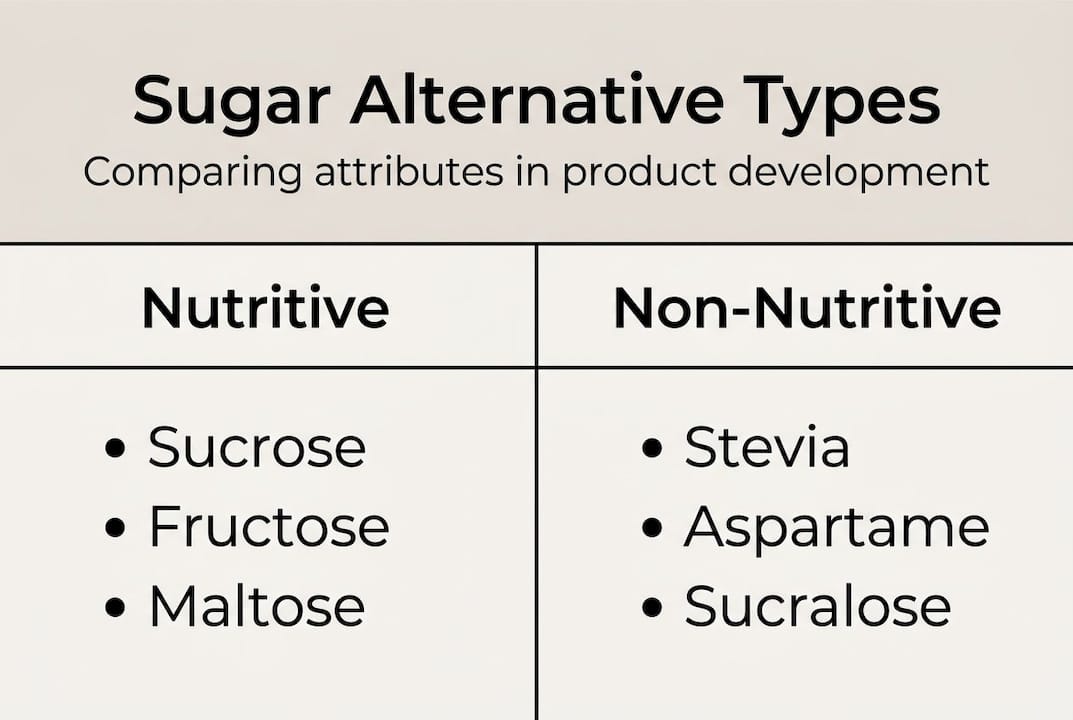
Nutritive sweeteners still provide calories but offer advantages over sucrose. Fructose, for example, has a lower glycemic index. Allulose is technically a rare sugar that provides roughly 0.4 calories per gram and behaves more like sucrose in cooking than most alternatives.
Non-nutritive sweeteners deliver little to no caloric contribution. This group includes both artificial options like aspartame, sucralose, and saccharin, and natural-origin options like stevia and monk fruit. Stevia is a leading plant-based zero-calorie sweetener used in global product launches, and its popularity continues to climb as brands chase clean-label positioning.
Polyols (sugar alcohols) like erythritol, xylitol, and sorbitol offer reduced-calorie profiles with functional properties that partially mimic sucrose. They’re common in confectionery, chewing gum, and baked goods.
Here’s a quick comparison of the most widely used options:
| Sweetener | Type | Calories/g | Sweetness vs. sucrose | Key use case |
|---|---|---|---|---|
| Stevia | Natural, non-nutritive | ~0 | 200-400x | Beverages, dairy |
| Monk fruit | Natural, non-nutritive | ~0 | 150-250x | Clean-label products |
| Erythritol | Polyol | 0.24 | 60-80% | Baked goods, confections |
| Xylitol | Polyol | 2.4 | ~100% | Gum, oral care, baking |
| Sucralose | Artificial, non-nutritive | ~0 | 600x | Beverages, table-top |
| Allulose | Rare sugar | 0.4 | 70% | Baking, sauces |
A few things worth noting when reviewing this list:
- Natural vs. artificial is not just a chemistry distinction. It shapes consumer perception and marketing claims.
- Plant-based sweeteners like stevia and monk fruit are surging in new product development, particularly in the US and European markets.
- Corn-derived sweeteners such as high-fructose corn syrup remain widely used in cost-sensitive formulations, though consumer scrutiny has increased.
- Regulatory approval varies by region. Always verify status for your target market.
Pro Tip: No two sweeteners behave identically in a food matrix. Stevia may perform well in a cold-brew beverage but create off-notes in a high-heat bakery application. Formulation expertise matters as much as ingredient selection.
Comparing functionality: How sugar alternatives impact product development
Knowing what types are available is only half the battle. The harder question is how they actually perform when you swap them into your existing formulas.
Sugar does far more than sweeten. It contributes bulk, controls water activity, drives Maillard browning, affects texture, and extends shelf life. When you remove it, you’re not just losing sweetness. You’re removing a multifunctional ingredient that dozens of other parameters depend on.

Polyols like erythritol can replicate some bulk and texture functions, but they lack the browning and mouthfeel identical to sucrose. That gap matters enormously in baked goods, confections, and sauces.
Here’s how major alternatives compare on key functionality benchmarks:
| Sweetener | Solubility | Maillard browning | Aftertaste risk | Heat stability | Bulk contribution |
|---|---|---|---|---|---|
| Erythritol | High | Low | Low | High | Moderate |
| Stevia | High | None | Moderate | High | None |
| Sucralose | High | None | Low | Moderate | None |
| Xylitol | High | Low | Low | Moderate | High |
| Allulose | High | High | Very low | High | Moderate |
| Monk fruit | Moderate | None | Low | High | None |
Allulose stands out here. It browns similarly to sucrose, which makes it particularly valuable in sugar alternatives for baking where color and crust development matter.
A practical formulation sequence most experienced developers follow:
- Assess the role of sugar in your specific product. Is it primarily sweetness, bulk, browning, or preservation?
- Shortlist alternatives that address your primary functional need first.
- Adjust secondary ingredients like starches, gums, or humectants to compensate for lost functionality.
- Run sensory panels alongside lab data. Texture and taste perception don’t always align with technical measurements.
“It’s not a 1:1 swap. When you change your sweetener, expect to adjust moisture levels, leavening ratios, and possibly processing temperatures.” — Industry formulation specialist
Understanding the role of sugar in baking before you substitute it is essential. Teams that skip this step tend to cycle through more reformulation rounds than necessary. For regulatory context on approved sweeteners, the FDA sweetener regulations page is the authoritative reference.
Consumer trends: Health perceptions and label implications
Formulation decisions don’t happen in a vacuum. Consumer behavior is reshaping what ingredients are acceptable, not just what’s technically functional.
Three major drivers are pushing manufacturers toward sugar alternatives right now:
- Calorie reduction remains the top motivation for consumers avoiding sugar, particularly in beverages and snacks.
- Diabetes management and blood sugar awareness are expanding the market for low-glycemic options beyond traditional diet categories.
- Clean label demand is pushing brands away from artificial sweeteners toward stevia, monk fruit, and allulose, even when those options cost more.
74% of US consumers report checking for sugar content or alternative sweeteners on labels. That’s not a niche behavior. It’s mainstream purchasing logic, and it affects every category from sweeteners in beverages to dairy and sauces.
Labeling is where consumer preference meets regulatory compliance. Terms like natural, non-GMO, and no added sugar carry specific legal definitions in the US. Using them incorrectly creates liability. Using them correctly creates competitive advantage.
The CDC guidance on added sugars recommends limiting added sugars to less than 10% of daily calories. That benchmark is now embedded in consumer awareness, and it’s influencing purchasing decisions across age groups.
For product developers, the practical implication is this: your sweetener choice is also a marketing decision. A product sweetened with monk fruit and labeled plant-based, no added sugar tells a story that resonates with today’s shopper. A product using aspartame tells a different one. Neither is inherently wrong, but both have distinct positioning consequences.
Procurement managers should also factor in supply chain stability. Stevia and monk fruit are both derived from crops with geographic concentration, which introduces sourcing risk. Exploring low-calorie sweetener options that have more diversified supply chains can reduce exposure during demand spikes or harvest disruptions.
Application strategies: Choosing the right sweetener for your product
With technical and market context established, the real question is how to move from analysis to decision. Here’s a four-step framework that works across product categories.
Step 1: Assess your product’s functional sugar requirements. Before you look at alternatives, map out exactly what sugar is doing in your current formula. Is it providing sweetness only, or is it also controlling texture, water activity, and shelf life? This determines which alternatives are even viable.
Step 2: Shortlist compatible alternatives based on primary function. If browning is critical, allulose moves to the top of your list. If you need zero calories and heat stability, sucralose or stevia are strong candidates. If bulk and mouthfeel matter, erythritol or xylitol deserve attention.
Step 3: Conduct lab-scale trials with blends. Stevia and erythritol blends offer balanced sweetness and improved mouthfeel in beverages and baked goods. Blending is often more effective than relying on a single alternative because different sweeteners compensate for each other’s weaknesses.
Step 4: Review sensory and shelf-life data before scaling. Lab data tells you what’s happening chemically. Sensory panels tell you whether consumers will actually buy it. Both are necessary before committing to a production run.
For teams working on baked goods specifically, resources on substituting sweetener in baking and best artificial sweetener for baking can accelerate your shortlisting process.
Pro Tip: Start with small-scale pilots before committing to full reformulation. Consumer feedback from a limited market test often reveals sensory issues that controlled lab panels miss, especially for texture and aftertaste at real-world serving sizes.
Blending also gives you more flexibility on cost. High-intensity sweeteners like stevia or monk fruit are expensive at scale. Pairing them with a functional polyol lets you reduce the amount of each while hitting your sweetness and texture targets.
Why the right sugar alternative is a competitive edge
Here’s what we’ve observed working with manufacturers across bakery, beverage, and confectionery: the brands that win with sugar alternatives aren’t the ones that follow trends the fastest. They’re the ones that treat sweetener selection as a strategic formulation decision, not a compliance checkbox.
Most reformulation projects fail not because the ingredient was wrong, but because the team didn’t fully map sugar’s functional role before substituting it. The result is a product that passes regulatory review but underperforms on shelf.
The real competitive edge comes from iterating on consumer feedback, building internal expertise in sweetener blending, and staying ahead of emerging science, not just regulation. Allulose, for example, was a fringe ingredient five years ago. Teams that invested in understanding it early now have a meaningful head start.
Insights from baking sweetener selection consistently show that the best outcomes come from developers who treat each reformulation as a learning opportunity, not a one-time fix. That mindset compounds over time into a genuine capability advantage.
Explore reliable bulk sugar alternatives with US Sweeteners
For product developers ready to move from strategy to sourcing, having a reliable supply partner makes all the difference.
US Sweeteners carries a broad range of bulk sugar alternatives including erythritol, stevia, allulose, and more, available at the volumes large-scale manufacturers require. Whether you’re reformulating an existing product or launching something new, our team can connect you with the right ingredients, product data sheets, and formulation guidance. We also support sweeteners for ingredient manufacturers who need consistent, compliant supply across multiple SKUs. If you’re specifically evaluating polyols, our bulk erythritol supply is available with flexible packaging and fast logistics to keep your production on schedule.
Frequently asked questions
What are the main challenges when replacing sugar with alternatives in processed foods?
Sugar alternatives differ in bulk, texture, and browning compared to sucrose, so replacing sugar typically requires adjustments to multiple recipe parameters, not just a straight substitution.
Which sugar alternative is considered the safest for large-scale use?
FDA-approved sweeteners including stevia, sucralose, and erythritol are recognized as safe for food manufacturing, though usage levels and application categories may vary by approval status.
How do consumer trends affect the choice of sugar substitute in new products?
74% of US consumers check labels for sugar or alternative sweeteners, which pushes manufacturers toward plant-based, clean-label ingredients that consumers recognize and trust.
Are blends of sugar alternatives more effective than using one?
Stevia and erythritol blends balance sweetness intensity with improved mouthfeel and texture, making them more effective than single-ingredient approaches in many product categories.