Organic Sugar vs. Conventional Sugar: What Food Manufacturers Need to Know
Organic claims and clean labels are no longer niche—they’re showing up in retailer line reviews, new product briefs, and internal strategy decks across the food and beverage industry. Many manufacturers are now asking a deceptively simple question: should we move from conventional sugar to organic sugar, and if so, where does it make business sense?
It’s not as straightforward as swapping one ingredient code for another. The decision touches formulation performance, flavor and color, cost of goods, supply chain risk, and whether your labels align with evolving consumer expectations around organic, non-GMO, and Kosher claims.
In this guide, we’ll break down the real-world differences between organic and conventional sugar for food and beverage manufacturers—from farm and certification requirements to functional performance on your production lines. We’ll close with a practical framework your R&D, QA, and procurement teams can use to decide where organic sugar adds value and where conventional sugar still belongs in your portfolio.
At USSweeteners.com, we’ve helped manufacturers across categories—bakery, beverage, confectionery, sauces, and more—evaluate and implement both organic and conventional sugar programs. Drawing on that experience, this article focuses on what actually matters when you move from discussion to trials to full-scale production.
What’s the Difference Between Organic and Conventional Sugar?
For most applications, organic and conventional sugar deliver the same core compound: sucrose. At a chemical level, they behave similarly. The real differences show up in how the sugar is grown, processed, documented, and ultimately positioned on your label.
Farming and Certification Standards
Organic sugar must be produced from crops grown under certified organic farming practices. That means:
-
No synthetic pesticides, herbicides, or fertilizers are used on the crop.
-
Farms and processors operate under the USDA National Organic Program (NOP) and are audited by accredited certifiers.
-
There is a documented chain of custody from field to mill to final packaging.
Conventional sugar, by contrast, is produced under standard agricultural practices that can include synthetic inputs and is not audited against organic standards. The supplier may still follow robust quality schemes (e.g., SQF, BRC), but those do not replace USDA Organic certification.
For your QA and regulatory teams, this difference translates into additional documentation and verification steps when onboarding an organic sugar supplier: organic certificates, handling procedures, and clear segregation protocols.
Processing and Refining Differences
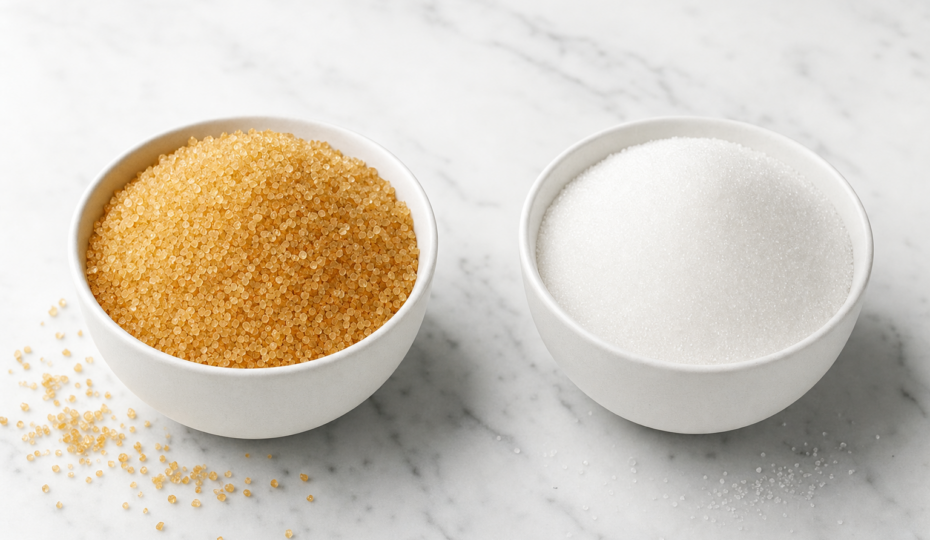
In many cases, organic sugar is slightly less refined than conventional granulated sugar. This can result in:
-
A light cream or tan color instead of a bright white appearance.
-
A subtle hint of molasses flavor and aroma.
-
Slight differences in trace minerals.
Conventional granulated sugar is typically fully refined for a neutral color and flavor, optimized for maximum consistency across applications.
In practice, these differences may or may not be noticeable in your finished products. For darker applications (like brown baked goods, chocolate, or sauces), they’re often negligible. For very light-colored products or delicate flavors, they can matter and should be evaluated through bench-top and plant trials.
Labeling Claims and Non-GMO Considerations
Organic sugar can support more than just an organic claim on your finished product:
-
USDA Organic sugar is inherently non-GMO, aligning well with non-GMO positioning and certifications.
-
Organic sugar can help move your overall formulation into “organic” or “made with organic” territory, depending on the percent of organic ingredients in the final product.
Conventional sugar does not, by itself, support organic claims, and non-GMO status may depend on the specific crop source and program.
Why Food Manufacturers Are Evaluating Organic Sugar
The shift toward organic sugar isn’t purely a consumer trend; it’s also driven by retailer expectations and strategic positioning.
Clean Label and Retail Buyer Expectations
Retailers and category managers increasingly expect brands to show at least one organic or “better-for-you” SKU in their lineup, especially in:
-
Snack and bakery items
-
Beverages
-
Kids’ products and family-focused categories
Organic sugar is often part of the ingredient strategy that helps products qualify for certain organic sets, natural channel distribution, or retailer-specific programs.
Beyond shelf access, organic sugar supports a range of label claims that can differentiate your brand on crowded shelves—particularly when paired with non-GMO and other quality or sustainability signals.
Consumer Perception and Brand Positioning
Consumers frequently associate “organic” with higher quality or “less processed,” even when they don’t fully understand the underlying agricultural practices. That perception can:
-
Reinforce premium positioning and justify price points in certain categories.
-
Help your brand align with health- and environment-conscious segments.
At the same time, not every shopper segment is willing or able to pay a premium for organic claims. Many manufacturers therefore use organic sugar strategically, layering it into select SKUs or channels rather than converting their entire portfolio at once.
Functional Performance in Formulations
One of the biggest questions from R&D teams is whether organic sugar will behave differently in formulations compared to conventional sugar. In most cases, the answer is “not much”—but you should still test.
Taste, Sweetness, and Browning
Because organic cane sugar is sucrose, its inherent sweetness level is comparable to conventional cane sugar. However, slight differences can emerge:
-
A faint caramel or molasses note may be detectable in certain applications.
-
Slightly more pronounced browning may occur in baked goods due to residual molasses and trace components.
For products where color and flavor consistency are critical (e.g., white frostings, vanilla fillings, light-colored beverages), these differences should be evaluated with sensory panels and side-by-side testing.
Solubility, Handling, and Production Line Performance
From a process perspective, organic sugar generally offers similar solubility and bulk to conventional sugar. Still, there are practical considerations:
-
Particle size and flow characteristics may differ between suppliers and product lines.
-
Dissolution time and mixing behavior can vary slightly, especially in high-solids systems or cold-process applications.
-
Dusting, clumping, and hopper flow can be influenced by storage conditions and packaging.
To avoid surprises at scale, it’s critical to run trials that simulate actual production conditions, including mixing times, temperature profiles, and storage.
Cost, Supply, and Risk Management
Organic sugar almost always carries a price premium over conventional sugar. That premium reflects lower yields, more intensive farming practices, certification costs, and a more complex supply chain.
Price Premiums and Total Cost of Ownership
When evaluating organic sugar, don’t look solely at the per-pound price. Consider:
-
Impact on total COGS for each SKU and category.
-
Potential for higher price points or margin contributions from organic or premium-positioned products.
-
Long-term plans for organic or clean-label positioning in your portfolio.
For some manufacturers, organic sugar works best in hero SKUs or flagship lines where consumers are more likely to value and pay for organic claims. For others, organic sugar becomes part of a broader brand repositioning.
Sourcing, Lead Times, and Supply Chain Resilience
Organic sugar supply is typically more constrained than conventional sugar supply. This can show up as:
-
Longer lead times, especially for large order volumes.
-
Greater sensitivity to weather events or regional disruptions in key growing areas.
-
Limited availability of specific formats or packaging configurations.
When you integrate organic sugar into your supply chain, it’s important to:
-
Build adequate lead time and safety stock into planning.
-
Clarify minimum order quantities and production schedules.
-
Establish contingency plans for demand spikes or supply disruptions.
Regulatory, Certification, and Audit Readiness
Organic sugar touches multiple compliance and documentation responsibilities within your organization, from QA to regulatory to supply chain.
USDA Organic Requirements for Sugar Ingredients
To label a finished product as “organic” in the U.S., both the sugar and the overall formulation must meet USDA Organic standards. That typically includes:
-
Using certified organic sugar from a USDA Organic-certified supplier.
-
Ensuring all other ingredients and processing aids align with organic rules.
-
Working with an organic certifier that approves and audits your processes and labels.
Even if your finished product is not fully organic, using organic sugar can still contribute to “made with organic” claims and non-GMO positioning.
Documentation Your QA and Regulatory Teams Will Need
When onboarding an organic sugar supplier, QA and regulatory teams commonly require:
-
Current USDA Organic certificates for the supplier and product.
-
Non-GMO documentation when relevant to your brand or customers.
-
Kosher certification, if you serve markets that require it.
-
Detailed specifications, COAs, allergen and contamination statements, and chain-of-custody documentation.
Choosing a supplier that anticipates and supports these documentation needs can significantly reduce onboarding friction and audit risk.
How to Decide: A Practical Framework for R&D, QA, and Procurement
Rather than debating organic vs. conventional sugar in the abstract, it helps to use a structured decision process.
Step 1: Clarify Your Objectives
Start by defining what you’re trying to achieve:
-
Are you chasing specific retailer or channel requirements?
-
Are you repositioning your brand toward organic or better-for-you territory?
-
Are you primarily aiming for non-GMO or clean-label alignment?
The clearer your objectives, the easier it is to make trade-offs on cost, complexity, and risk.
Step 2: Map SKUs and Channels
Next, map your current and upcoming SKUs:
-
Identify products where organic or non-GMO claims are most likely to drive incremental revenue or distribution.
-
Consider channels (e.g., natural retailers, club stores, e-commerce) that may value organic positioning more.
Many manufacturers start by piloting organic sugar in a limited subset of SKUs or channels rather than rolling it out across the board.
Step 3: Run Bench and Plant Trials
Once you’ve narrowed the list:
-
Conduct bench-top trials to assess flavor, color, texture, and performance.
-
Follow with plant trials to observe flow, mixing, dissolution, production speeds, and yield.
-
Compare shelf-life and stability across test and control batches.
Capture data not just on sensory attributes but also on line efficiency and QA results.
Step 4: Build a Cost and Risk Model
Evaluate both financial and operational impacts:
-
Calculate COGS differences for each candidate SKU.
-
Model supply risks and mitigation strategies (e.g., multiple suppliers, contracts).
-
Evaluate documentation and audit implications for organic, non-GMO, and Kosher claims.
This helps your leadership team understand where organic sugar adds strategic value and where conventional sugar may remain the better fit.
Step 5: Choose a Sourcing Strategy
Finally, select an approach that fits your objectives and risk tolerance:
-
Full conversion: move entire product lines to organic sugar where the business case is strong.
-
Hybrid portfolio: use organic sugar in select SKUs or channels while maintaining conventional sugar in others.
-
Phased testing: start with limited runs or regional launches, then expand based on performance and feedback.
Throughout this process, partnering with a supplier experienced in both organic and conventional programs can streamline evaluation and implementation.
How US Sweeteners Supports Organic and Conventional Sugar Programs
At US Sweeteners, we supply both conventional and bulk organic sugar options to help manufacturers build flexible, resilient sweetener programs tailored to their product mix and risk profile.
For customers pursuing clean label and organic claims, we offer:
-
USDA Organic sugar options to support certified organic products.
-
Non-GMO organic sugar for brands targeting non-GMO positioning.
-
Kosher-certified sugar, helping you serve markets with religious or export requirements more easily.
Our team works closely with R&D, QA, and procurement to align ingredient specs, documentation, and supply plans with your brand’s label and compliance targets. Whether you’re launching a new organic line, adding an organic extension to a legacy product, or maintaining a hybrid portfolio, we can help you design a program that balances cost, performance, and risk.
If you’re ready to explore options, you can review our bulk organic sugar offerings—specifications, packaging formats, and availability—and request a quote or technical consultation with our sourcing team.
Frequently Asked Questions
Is organic sugar healthier than conventional sugar?
From a nutritional standpoint, organic sugar and conventional sugar are both primarily sucrose and provide similar calories and metabolic effects. The distinction lies more in how the sugar is grown and processed than in how it behaves in the human body. For manufacturers, the key value of organic sugar is in label claims, consumer perception, and alignment with broader organic or non-GMO positioning.
Do I need to change my formulation when switching to organic sugar?
In many cases, you can substitute organic cane sugar at a 1:1 level without major changes to your formulation. However, because organic sugar may have slightly different color or trace flavor, especially in delicate applications, it’s best practice to run bench and plant trials and adjust if needed.
How much more does organic sugar cost compared to conventional sugar?
Organic sugar typically carries a noticeable price premium over conventional sugar due to lower yields, higher farming and certification costs, and a more constrained supply chain. The specific premium depends on market conditions, volumes, and contract structures, so it’s important to evaluate COGS impact at the SKU level and consider where organic claims will deliver sufficient value.
What certifications should I look for in an organic sugar supplier?
Look for suppliers who can provide current USDA Organic certification for both their facility and product. If your brand emphasizes non-GMO positioning, ensure they can also provide appropriate non-GMO documentation. For many markets and customers, Kosher certification is another important requirement. Having all three in place can significantly simplify audits, retailer onboarding, and regulatory reviews.
Can I mix organic and conventional sugar in the same facility?
Yes, many manufacturers run both organic and conventional sugar in the same facility, but strict procedures are needed to maintain certification and prevent cross-contact. That often involves scheduling, segregation, cleaning protocols, and detailed documentation. Work with your organic certifier and supplier to design a process that meets certification requirements and fits your production realities.

Thomas is a product expert at US Sweeteners, a trusted bulk sugar and sweetener distributor serving food and beverage manufacturers across the USA. He writes about sweetener sourcing, ingredient trends, and supply chain insights for the food industry.