Most food manufacturers assume sugar refining is simply about making raw sugar white. That misconception costs production efficiency. Refining is actually a multi-stage transformation that converts raw agricultural inputs into high-yield, industrial-grade sucrose with precise purity, color, and particle specifications. For bakeries managing moisture-sensitive doughs, breweries demanding consistent fermentable sugars, and dairies requiring clean-label ingredients, the refining process directly determines product performance. Understanding what happens between the field and your bulk delivery unlocks smarter sourcing decisions, better contract negotiations, and fewer production surprises.
Table of Contents
- What is sugar refining? The industrial process explained
- Core steps and technologies: Extraction, clarification, and purification
- Beet vs cane sugar refining: Processes, yields, and practical nuances
- Economic and quality factors: Cost benchmarks, margins, and sourcing
- A manufacturer’s perspective: What most guides miss about sugar refining
- Bulk sugar solutions for industrial manufacturing
- Frequently asked questions
Key Takeaways
| Point | Details |
|---|---|
| Industrial refining process | Sugar refining transforms raw crops into high-yield, purified sweeteners tailored for industrial use. |
| Beet vs cane advantages | Beet sugar processes yield more and are easier to desugarize, while cane requires additional steps and controls. |
| Economic impact | Process choices and yield optimization drive lower costs and higher margins for bulk buyers. |
| Critical controls | Proper clarification, pH management, and resin maintenance are essential for quality and profit. |
| Practical sourcing | Manufacturers can streamline production and quality by sourcing from specialized bulk suppliers. |
What is sugar refining? The industrial process explained
Sugar refining is the process of converting raw sugar extracted from either sugarcane or sugar beets into purified, food-grade sucrose suitable for industrial manufacturing. It is not just one step. It is a sequence of physical and chemical operations designed to remove impurities, minimize color bodies, and maximize sucrose yield per ton of raw input.
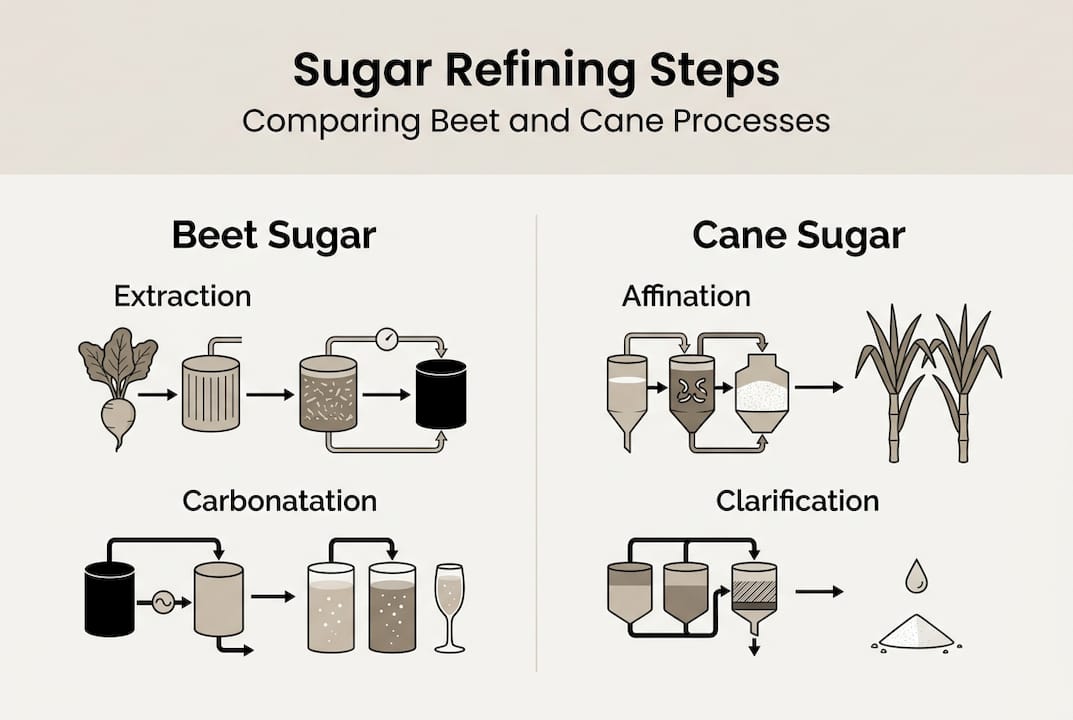
A good sugar processing overview shows that both beet and cane go through broadly similar goals but very different routes. Cane sugar processing typically begins with affination, a step where raw sugar crystals are washed in a warm syrup to remove the impurity-laden molasses film coating each crystal. Beet sugar skips this entirely because beet processing works from fresh juice rather than pre-crystallized raw sugar. Understanding this difference early sets the foundation for every sourcing and quality decision downstream.
For cane, the core stages include:
- Affination: Washing raw cane crystals to strip surface molasses
- Carbonatation or phosphatation: Clarifying the resulting liquor using lime and either CO2 or phosphoric acid to precipitate impurities
- Decolorization: Using activated carbon, bone char, or ion-exchange resins to strip color compounds
- Crystallization: Controlled evaporation to form sucrose crystals at specific size and purity targets
- Centrifugation and drying: Separating crystals from mother liquor and reducing moisture to specification
Beet sugar refining takes a more direct path. Beet sugar factories slice fresh beets into thin strips called cossettes, then use hot water diffusion to extract juice at a sucrose yield of roughly 15 to 18% by weight. Carbonatation clarification, which uses lime and CO2 to form calcium carbonate as a natural filter aid, cleans the juice without affination. Beet refiners often also run molasses desugarization through ion-exchange chromatography, recovering up to 90% of additional sucrose that would otherwise be lost in byproduct streams.
“The yield efficiency gap between optimized beet refining and sub-optimized cane refining can represent millions of dollars annually for large-scale processors.”
Pro Tip: When evaluating suppliers, ask specifically about their sucrose yield per ton of input and their desugarization practices. A supplier optimizing yield means more consistent pricing and fewer shortages during tight market cycles. You can also review liquid sugar production processes to understand how refined sucrose feeds into dissolved and liquid sweetener formats.
Core steps and technologies: Extraction, clarification, and purification
Let’s break down each stage in detail for a clearer picture. The sequence matters because an error at any step compounds through every stage that follows.
- Slicing and diffusion: Beet cossettes or crushed cane are contacted with hot water to extract sucrose into an aqueous juice. Temperature and contact time are tightly controlled to maximize yield without degrading sucrose.
- Clarification: Raw juice carries suspended solids, proteins, and colorants. Carbonatation (beet) or phosphatation (cane) uses lime reactions to precipitate these as a filterable mass. Poor clarification here means high color and elevated impurities carry into every downstream step.
- Filtration: The precipitate is removed using rotary vacuum filters or membrane systems, producing a clarified thin juice.
- Decolorization and ion-exchange: Thin juice passes through ion-exchange resin beds that strip colorants, organic acids, and inorganic ions. Resin fouling from organics or microbial contamination is a real operational risk and sugar refining data shows it requires quarterly cleaning cycles to maintain performance.
- Evaporation and crystallization: Multi-effect evaporators concentrate the purified juice into a thick syrup called massecuite. Controlled seeding and cooling drives sucrose crystallization at target crystal size.
- Centrifugation: Crystals are separated from the residual mother liquor. The liquor either recycles through the process or becomes molasses.
- Drying and conditioning: Final moisture is reduced to specification, usually below 0.05%, to prevent caking during bulk storage and transport.
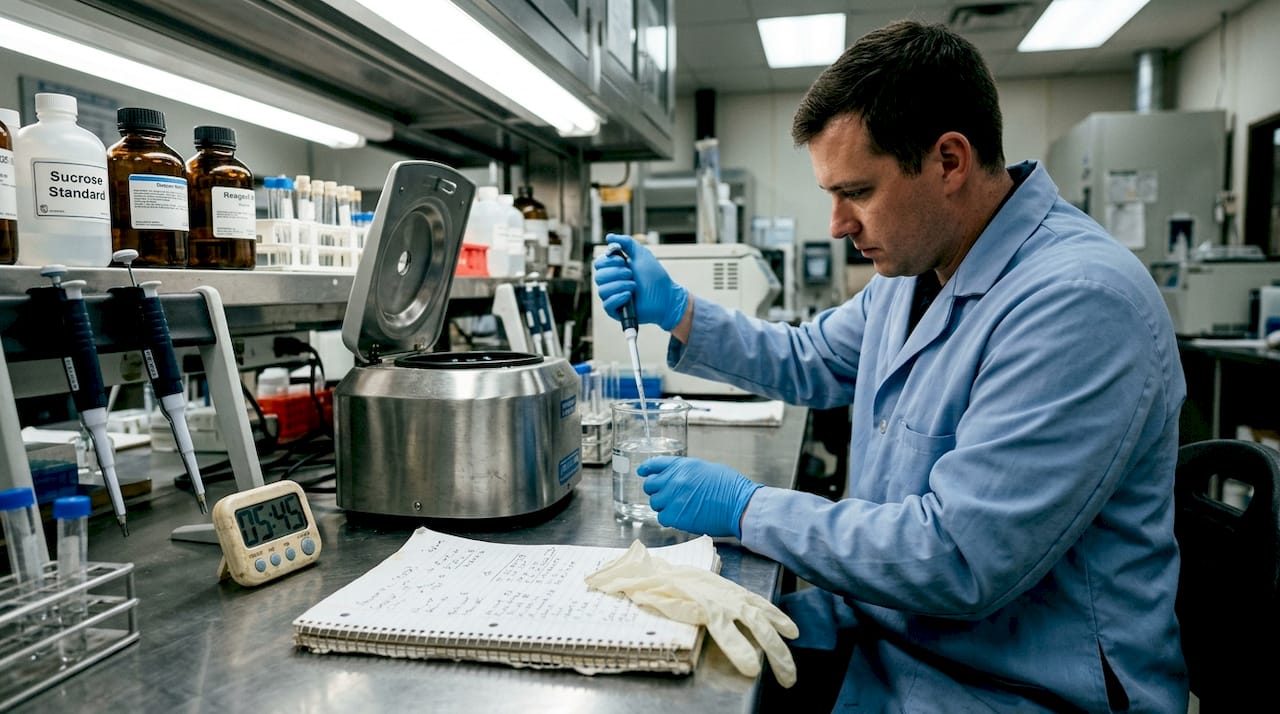
Three failure points dominate industrial refining problems. First, pH mismanagement. Sucrose inversion occurs when pH drops below 7, breaking sucrose into glucose and fructose and permanently reducing yield and purity. Maintaining pH between 7 and 8.5 throughout processing is non-negotiable. Second, resin fouling in ion-exchange systems silently erodes decolorization performance. Third, rushing crystallization produces inconsistent crystal sizes that cause handling and dissolution problems in downstream manufacturing.
Pro Tip: When qualifying a new bulk sugar supplier, request their ion-exchange resin maintenance logs and pH control records. These two data points reveal more about actual process quality than any certificate of analysis alone.
Cane molasses contains only about 35% recoverable sucrose with high viscosity and complex impurity profiles, making desugarization far harder than beet molasses at 60% recoverable sucrose.
For manufacturers comparing source materials, reviewing the beet vs cane sugar process in detail helps translate these technical differences into practical sourcing decisions.
Beet vs cane sugar refining: Processes, yields, and practical nuances
As we’ve seen, both beet and cane are central to sugar refining, but their approaches and industry impacts contrast sharply. The table below summarizes the key operational and economic differences.
| Factor | Beet sugar refining | Cane sugar refining |
|---|---|---|
| Starting material | Fresh beet cossettes | Raw cane crystals |
| Affination required | No | Yes |
| Clarification method | Carbonatation | Carbonatation or phosphatation |
| Decolorization | Ion-exchange (no bone char) | Bone char, activated carbon, or ion-exchange |
| Sucrose yield | ~15 to 18% of beet weight | Varies by raw quality |
| Molasses sucrose content | ~60% (recoverable) | ~35% (difficult to recover) |
| Desugarization recovery | Up to 90% via ion-exchange | Limited due to impurities |
Beet’s structural advantage is significant. Direct beet processing skips affination entirely and leverages carbonatation for cleaner clarification. The higher sucrose concentration in beet molasses means ion-exchange desugarization genuinely recovers meaningful volume. That changes the economics of byproduct management substantially.
Cane refining carries additional complexity. The raw cane crystal surface is coated with a high-impurity molasses film that must be stripped before any further processing. Cane molasses desugarization is technically challenging given the 35% sucrose content and high-viscosity matrix loaded with colorants, amino acids, and organic acids. Bone char, a traditional cane decolorization method, is also a sourcing concern for manufacturers with vegan or kosher label requirements.
For manufacturers, the practical implications are:
- Beet sugar tends to deliver more consistent purity and color specifications, which matters for white confectionery, dairy, and beverage applications
- Cane sugar brings distinct flavor profiles prized in certain bakery and brewing applications where trace molasses characters contribute to product character
- Sourcing flexibility across both streams, as detailed in sugar beet facts, protects against regional supply disruptions
Understanding what sugar is made from at an ingredient level also helps procurement teams ask better questions when qualifying new suppliers. And for manufacturers specifically evaluating cane sugar refining standards, the process nuances directly affect your finished product specs.
Economic and quality factors: Cost benchmarks, margins, and sourcing
Let’s connect these process details to the economics and sourcing realities food manufacturers face. Refining choices ripple directly into your input costs and production margins.
Global cost benchmarks show Brazil’s raw sugar cost of production sits around $335 per metric ton while EU refined sugar runs approximately $750 per metric ton. That spread reflects not just regional input costs but the full burden of refining operations. For industrial users, prioritizing yield efficiency above 80% gross margin through process control matters far more than chasing spot price movements.
Here is how refining economics translate for manufacturers making sourcing decisions:
- Yield efficiency drives unit cost: A refinery recovering 90% sucrose from molasses via ion-exchange produces more sellable sugar from the same raw input. That yield advantage can absorb cost volatility without raising contract prices.
- Process quality reduces your downstream waste: High-purity refined sugar with consistent crystal size reduces dissolution time, lowers rework rates in baked goods, and minimizes filtration load in beverage production.
- Spot price vs contract stability: Buying refined sugar on spot markets exposes you to price swings driven by harvest cycles. Volume contracts with quality-verified suppliers lock in both price and specification.
- Impurity carry-through costs: Sugar with elevated color bodies or invert sugar (from pH failures) can cause browning defects in baked goods, fermentation inconsistencies in brewing, and texture problems in dairy. The cost of reformulation or rework far exceeds any savings from lower-grade sugar.
| Sugar type | Approximate cost range | Key cost driver |
|---|---|---|
| Brazil raw cane | ~$335/MT | Low labor and agricultural cost |
| EU beet refined | ~$750/MT | Energy, processing complexity |
| US domestic refined | Market-dependent | Tariff structure and logistics |
Pro Tip: Review what foods contain refined sugar specifications for your product category before negotiating contracts. Knowing your exact purity and color requirements in ICUMSA units prevents you from paying for over-specification or accepting under-spec supply.
A manufacturer’s perspective: What most guides miss about sugar refining
Most technical guides treat sugar refining as a chemistry problem. It is not. It is a process optimization and risk management problem with chemistry as the mechanism.
The manufacturers who get into trouble are the ones who evaluate sugar solely on certificate of analysis values at delivery. By the time sugar arrives at your facility, the critical control points, pH management, resin maintenance, crystallization control, have already happened. You have no leverage on process quality after the fact.
The smarter approach is qualifying your supply chain at the process level before committing to volume. Ask about pH logs. Ask about resin replacement schedules. Ask whether molasses is desugarized or simply sold off. These questions separate suppliers with genuine process discipline from those who pass basic specs on good days only. For manufacturers comparing sourcing options, reviewing key refining differences between beet and cane at the processing level is where the real sourcing intelligence lives.
Yield and purity are not just specs on a data sheet. They are your margin. Every percentage point of invert sugar in a batch of supposedly refined white sugar is sucrose you paid for but cannot use as intended.
Bulk sugar solutions for industrial manufacturing
For manufacturers ready to source refined sugar in bulk, reliable partners and supply chains are essential.
US Sweeteners supplies industrial-grade bulk refined sugars and sweeteners to bakeries, breweries, dairies, confectioners, and large-scale food processors across the United States. With nearly two decades of experience sourcing from international mills and domestic suppliers, we match your purity, color, and packaging specifications to your production requirements. Our multiple warehouse locations support fast, high-volume delivery without supply gaps. Whether you need granulated white, liquid sucrose, or specialty sweetener formats, explore our bulk sugar supplier services or browse our full range of bulk sweeteners to find the right fit for your operation.
Frequently asked questions
What is the difference between beet and cane sugar refining?
Beet sugar uses direct extraction and carbonatation clarification without affination, while cane sugar requires affination to remove molasses film first. Beet molasses holds around 60% recoverable sucrose versus only 35% in cane, making beet desugarization via ion-exchange far more productive.
Why is pH control important in sugar refining?
Maintaining pH between 7 and 8.5 prevents sucrose inversion, which permanently converts sucrose into glucose and fructose and reduces both yield and purity in every downstream step.
How does sugar refining impact cost for food manufacturers?
Process efficiency drives the real economics: Brazil raw sugar costs around $335 per metric ton while EU refined reaches $750 per metric ton, and yield optimization above 80% gross margin matters far more than spot price.
What are common pitfalls in sugar refining processes?
Poor clarification, pH mismanagement, resin fouling in ion-exchange systems, and incomplete molasses desugarization are the four most common causes of reduced sucrose yield and purity failures in industrial refining.
How is additional sucrose recovered from beet molasses?
Ion-exchange chromatography separates sucrose from non-sugar components in beet molasses, recovering up to 90% of additional sucrose that would otherwise leave the refinery as byproduct.
Recommended
- Is Cane Sugar Refined? Process and Benefits Explained – US Sweeteners
- How Sugar Processing Affects Sourcing for Food Manufacturers
- Refined Sugar Examples: Common Types and Uses – US Sweeteners
- Top Sugar Trends Shaping the Food Industry in 2026

Thomas is a product expert at US Sweeteners, a trusted bulk sugar and sweetener distributor serving food and beverage manufacturers across the USA. He writes about sweetener sourcing, ingredient trends, and supply chain insights for the food industry.