
Getting the sweetness right in reduced-sugar or no-sugar products is one of the most technically demanding challenges in food formulation. Consumers want products that taste like the real thing, but off-notes, bitterness, and lingering aftertastes are constant obstacles. The good news is that receptor-level synergy data and refined sensory science now give R&D teams a structured path forward. This guide walks through the full process, from clarifying your formulation goals and selecting the right ingredient toolkit, to running bench trials, verifying sensory performance, and preparing for commercial scale. If you are building a custom sweetener blend that needs to hold up in the real world, this is your roadmap.
Table of Contents
- Assessing your starting point: Goals, constraints, and ingredient options
- Designing your blend: Selecting sweetener combinations and ratios
- Blending and bench trials: Practical lab execution
- Verification, adaptation effects, and advancing from bench to pilot scale
- A critical perspective: Why sensory data alone isn’t enough for custom blends
- Scaling up with US Sweeteners for your next custom blend
- Frequently asked questions
Key Takeaways
| Point | Details |
|---|---|
| Preparation is critical | Clarifying goals, constraints, and sweetener options sets the stage for successful custom blends. |
| Synergy boosts taste | Pairing the right sweeteners can reduce bitterness and deliver a sugar-like sweetness profile. |
| Lab trials refine results | Iterative bench testing and sensory screening identify the most acceptable blend. |
| Adaptation matters | Combining sugar with LCS helps prevent taste adaptation and supports repeat acceptance. |
| Scale-up needs expertise | Operational and consumer feedback are vital when moving from lab sample to commercial production. |
Assessing your starting point: Goals, constraints, and ingredient options
Before you touch a scale or open a sensory panel, you need a clear picture of what success looks like for your specific product. That means defining your caloric reduction targets, cost parameters, mouthfeel requirements, and any labeling commitments your marketing team has already made. A beverage targeting a “natural” claim operates under very different constraints than a bakery filling that needs browning and bulk.
Regulatory and labeling constraints should be mapped early. Confirm GRAS status for every ingredient in your target markets, check for allergenicity concerns (some flavor maskers carry trace protein risks), and verify whether your “natural” or “clean-label” claim survives the ingredient list you are building. These constraints will eliminate certain options before you run a single taste test.
Your ingredient toolkit for custom blends typically spans four categories:
- Bulk sweeteners: Erythritol, sorbitol, maltitol, and allulose provide body, mouthfeel, and partial sweetness. They are essential when you need to replace sugar’s physical functions, not just its taste.
- High-intensity sweeteners (HIS): Stevia glycosides (Reb A, Reb D, Reb M), sucralose, acesulfame-K, neotame, and mogroside V deliver sweetness at fractions of a gram. Each has a distinct onset, offset, and off-note profile.
- Flavor maskers and modifiers: Glycine, certain cyclodextrins, and natural flavor compounds suppress bitterness or round out harsh edges without contributing sweetness themselves.
- Functional carbohydrates: Small amounts of glucose, fructose, or invert sugar can anchor the blend’s temporal profile and reduce adaptation effects at commercial use levels.
The table below summarizes the main options and their typical application strengths:
| Sweetener | Sweetness vs. sucrose | Key strength | Common applications |
|---|---|---|---|
| Erythritol | 0.6x | Cooling, clean taste, bulking | Beverages, confections, baked goods |
| Allulose | 0.7x | Sugar-like mouthfeel, browning | Bakery, dairy, sauces |
| Reb A | 200-300x | Natural, cost-effective | Beverages, dairy |
| Reb D / Reb M | 200-350x | Reduced bitterness vs. Reb A | Premium beverages, ice cream |
| Sucralose | 600x | Heat stable, fast onset | Baked goods, beverages |
| Acesulfame-K | 200x | Synergy booster, fast onset | Blends, beverages |
| Neotame | 7000-13000x | Flavor enhancer at trace levels | Blends, dairy |
| Mogroside V | 200-300x | Natural, clean finish | Clean-label beverages |
For sweeteners for baking mixes, allulose and erythritol are frequently paired with small amounts of sucralose to preserve browning and structure. For sweeteners for beverage manufacturing, stevia glycoside blends are increasingly the anchor ingredient. Research confirms that Reb A blended with Reb D/M significantly lowers bitter taste (p<0.05) and increases consumer liking in ice cream, validating the clean-label blend strategy. Receptor assay data further shows that sucralose/acesulfame-K and rebaudioside A/erythritol combinations enhance sweetness perception without adding bitterness, confirming synergies at the TAS1R2/TAS1R3 receptor level.
Designing your blend: Selecting sweetener combinations and ratios
With your requirements and toolkit defined, the next phase is engineering the ideal blend anchored in current sensory science. The three principles that govern blend design are synergy, temporal profile matching, and bitterness suppression.
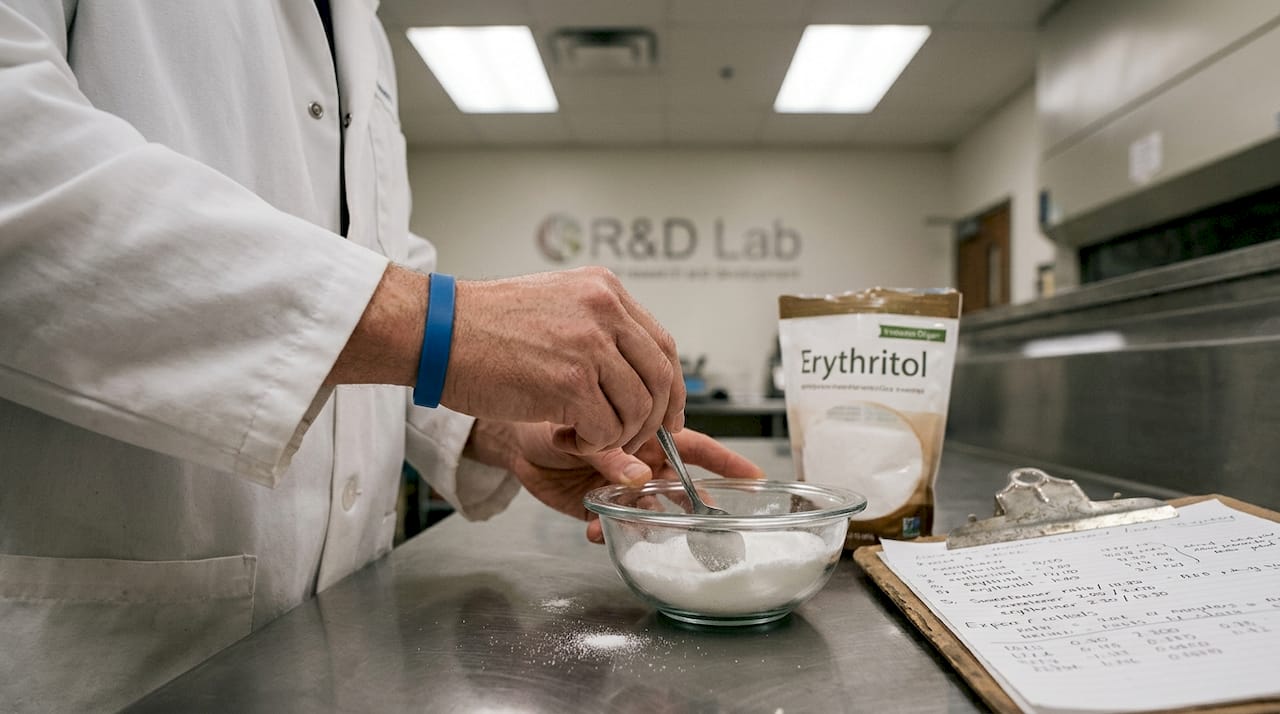
Synergy means two sweeteners together produce more perceived sweetness than the sum of their individual contributions. This is not marketing language. It is a receptor-level phenomenon. Synergies confirmed at receptor level include sucralose/acesulfame-K, rebaudioside A/erythritol, neotame/D-allulose, and mogroside V/thaumatin. Using these pairs lets you reduce total HIS loading while maintaining target sweetness intensity.
Temporal profile matching means aligning the onset and offset of each sweetener to mimic sucrose’s curve. Sucrose peaks quickly and fades cleanly. Most HIS either lag on onset (stevia) or linger on offset (sucralose, acesulfame-K). Blending a fast-onset sweetener like sucralose with a mid-profile ingredient like stevia creates a more sugar-like curve than either alone.
Here is a practical blend selection process:
- Define your target sweetness equivalence (e.g., 10% sucrose solution) and your acceptable HIS loading based on cost and regulatory limits.
- Select your anchor HIS based on application: stevia glycosides for natural/clean-label, sucralose for heat-stable applications.
- Choose a synergy partner from the receptor-confirmed pairs above to boost intensity and reduce off-notes.
- Add a bulk sweetener or modifier to address mouthfeel, body, and bitterness. Erythritol and allulose are the most versatile choices here.
- Set initial ratios based on published sensory data and your application matrix, then prepare trial batches at three ratio variations per combination.
Pro Tip: Always include at least one bulk sweetener or flavor masker in your blend. HIS-only formulas almost always miss on mouthfeel and show harsher adaptation effects over time. Erythritol at 2 to 4% in a beverage or glycine at 0.1% in a stevia-forward blend can make a measurable difference in panel scores.
For sweeteners for icings, a common starting point is Reb M plus erythritol plus a trace of sucralose, which balances sweetness intensity, clean finish, and cost. The table below shows reference blend profiles:
| Blend | Typical ratio | Best use case |
|---|---|---|
| Reb A + Reb D + Reb M | 50/30/20 | Ice cream, dairy beverages |
| Sucralose + Ace-K | 1/1 to 2/1 | Carbonated beverages, baked goods |
| Reb A + Erythritol + Glycine | Varies by target Brix | Still beverages, supplements |
| Neotame + D-Allulose | Trace neotame + 5-8% allulose | Bakery, sauces |
Blending and bench trials: Practical lab execution
Once you have narrowed your blend formula options, it is time to translate theory into physical samples. Bench execution discipline separates formulations that look good on paper from ones that actually pass a sensory panel.
Follow this sequence for each trial batch:
- Weigh all components to four decimal places. HIS are active at ppm levels, and even small weighing errors shift the sensory profile significantly.
- Pre-dissolve high-intensity sweeteners in a small volume of warm water (40 to 50°C) before combining with bulk ingredients. This prevents localized concentration hot spots that skew panel results.
- Combine under controlled conditions, matching the pH, temperature, and matrix of your target product as closely as possible. A beverage blend evaluated in water will behave differently in a 3.5 pH juice matrix.
- Prepare at least three ratio variants per combination, bracketing your calculated optimum by plus and minus 15%.
- Run triangle and paired comparison panels with a minimum of six trained evaluators at the screening stage. Advance to consumer panels (n=30 minimum) only after trained panels confirm a shortlist of two to three candidates.
- Score each sample for sweetness intensity, bitterness, lingering, and overall liking using a structured ballot. Document every result with the exact formulation used.
Caution: Small ratio shifts can dramatically alter the overall sensory profile. A 10% increase in acesulfame-K loading can push bitterness scores above threshold even when sucralose remains constant. Document every change, no matter how minor.
Research confirms that Reb A blended with Reb D/M significantly lowers bitter taste scores (p<0.05) and improves consumer liking in ice cream, which means the ratio between Reb A and its higher-purity siblings is one of the most sensitive variables in your blend. For sweeteners for frozen prepared foods, this ratio sensitivity is especially critical because freezing concentrates flavor perception.
Pro Tip: Prepare samples at multiple storage intervals (day 0, day 7, day 14) to check sweetness stability. Some HIS degrade or migrate in certain matrices, and a blend that scores well fresh may shift noticeably after two weeks on shelf.
Verification, adaptation effects, and advancing from bench to pilot scale
After initial lab wins, the final step is ensuring your blend holds up both sensorially and operationally as you move toward commercial production. Verification is not a single test. It is a structured sequence.
For final sensory verification, use:
- Trained descriptive panels to map the full sensory profile of your top candidate against a sucrose reference.
- Consumer acceptance screening with your target demographic, focusing on repeat sip/bite scores to catch adaptation effects.
- Shelf-life checks at accelerated conditions (38°C/75% RH for 4 weeks as a proxy for 6 months ambient) to confirm the blend is stable in your packaging format.
- Regulatory re-check to confirm that scale-up ingredient sourcing does not introduce new labeling requirements.
Adaptation (also called desensitization) is one of the most underestimated risks in LCS-forward formulations. When a receptor is continuously stimulated by a single sweetener, perceived sweetness drops over the course of a meal or even a single serving. Sugar plus LCS blends reduce adaptation measurably: sucralose alone shows approximately 66% adaptation, while glucose/fructose blended with sucralose at commercial ratios drops that figure to around 38%. For products consumed in multiple sips or bites, this is a critical performance differentiator.
A well-documented case study illustrates the ceiling that is achievable: high-purity Reb A 97% combined with erythritol and glycine masked stevia bitterness in a still beverage and achieved 92% sensory approval in consumer testing. That result required precise sourcing of high-purity material, not just the right ratio. For sweeteners for supplements, where bitterness from active ingredients compounds the challenge, this kind of multi-component masking strategy is often the only path to acceptable palatability.
Scale-up introduces new variables. Mixing method matters: high-shear mixing can alter the physical form of erythritol crystals, changing mouthfeel. Ingredient sourcing consistency matters: Reb A from different suppliers can vary in glycoside purity profile, shifting the bitterness baseline. Build sourcing specifications into your pilot protocol before you commit to a commercial launch formula.
A critical perspective: Why sensory data alone isn’t enough for custom blends
With a validated approach in hand, it is worth pausing to reflect on where even robust sensory data can fall short. The most common failure mode we see is not a bad formula. It is a good formula that never survives the handoff from R&D to operations.
Bench-optimized blends can break down at scale for reasons that have nothing to do with sweetener chemistry. Mixing sequence changes, ingredient substitutions driven by procurement cost pressure, and packaging format switches all alter the sensory outcome. A team that treats the formula as a fixed answer rather than a starting hypothesis will be caught off guard every time.
The teams that consistently reach market with winning products treat the formula as a living document. They loop in operations early to flag mixing constraints. They work with supply chain to lock in ingredient specifications before pilot, not after. They run consumer testing in the actual product format, not a lab proxy. And they use co-manufacturer sweetener partnerships to maintain ingredient consistency across production sites.
Sensory science gives you the map. Cross-functional execution is what gets you to the destination.
Scaling up with US Sweeteners for your next custom blend
When you are ready to move from lab prototypes to pilot or commercial scale, partnering with a dependable ingredient supplier becomes essential. Sourcing consistency, lead time reliability, and access to a broad sweetener portfolio all directly affect whether your validated formula survives the transition to production.
US Sweeteners works directly with R&D and procurement teams at large-scale food and beverage manufacturers, providing bulk access to the full range of functional sweeteners covered in this guide. From bulk sugar supplier services to bulk liquid sugar formats and specialty HIS, our inventory and logistics infrastructure are built for high-volume, specification-critical orders. Whether you are sourcing erythritol, stevia glycosides, or a custom-spec blend component, our team can support your beverage manufacturing sweeteners needs from first sample request through full commercial supply.
Frequently asked questions
What are the best sweetener combinations to mask bitterness?
Stevia glycoside blends such as Reb A, D, and M paired with erythritol are among the most effective options, and Reb A blended with Reb D/M has been shown to significantly lower bitter taste scores (p<0.05) in consumer studies. Sucralose/acesulfame-K combinations also provide robust sweetness with minimal bitterness when used at synergistic ratios.
How does sweetener blending affect consumer taste adaptation?
Blends that include a small amount of sugar alongside low-calorie sweeteners maintain perceived sweetness better over time than LCS-only formulas. Sugar plus LCS blends reduce adaptation from approximately 66% with sucralose alone down to around 38% when glucose or fructose is included at commercial ratios.
What’s a typical process for bench-testing a custom blend?
Prepare small batches at multiple ratio variants, pre-dissolve your high-intensity sweeteners, and run structured triangle or paired comparison panels before advancing to consumer testing. A high-purity Reb A plus erythritol and glycine combination achieved 92% sensory approval in beverages using exactly this iterative approach.
Are stevia-based blends suitable for clean-label products?
Yes, steviol glycoside blends using only Reb A, D, and M combined with natural bulk sweeteners like erythritol can meet clean-label criteria. Reb A blended with Reb D/M delivers natural bitterness reduction without artificial additives, making it a strong fit for clean-label formulations across beverages and dairy.